

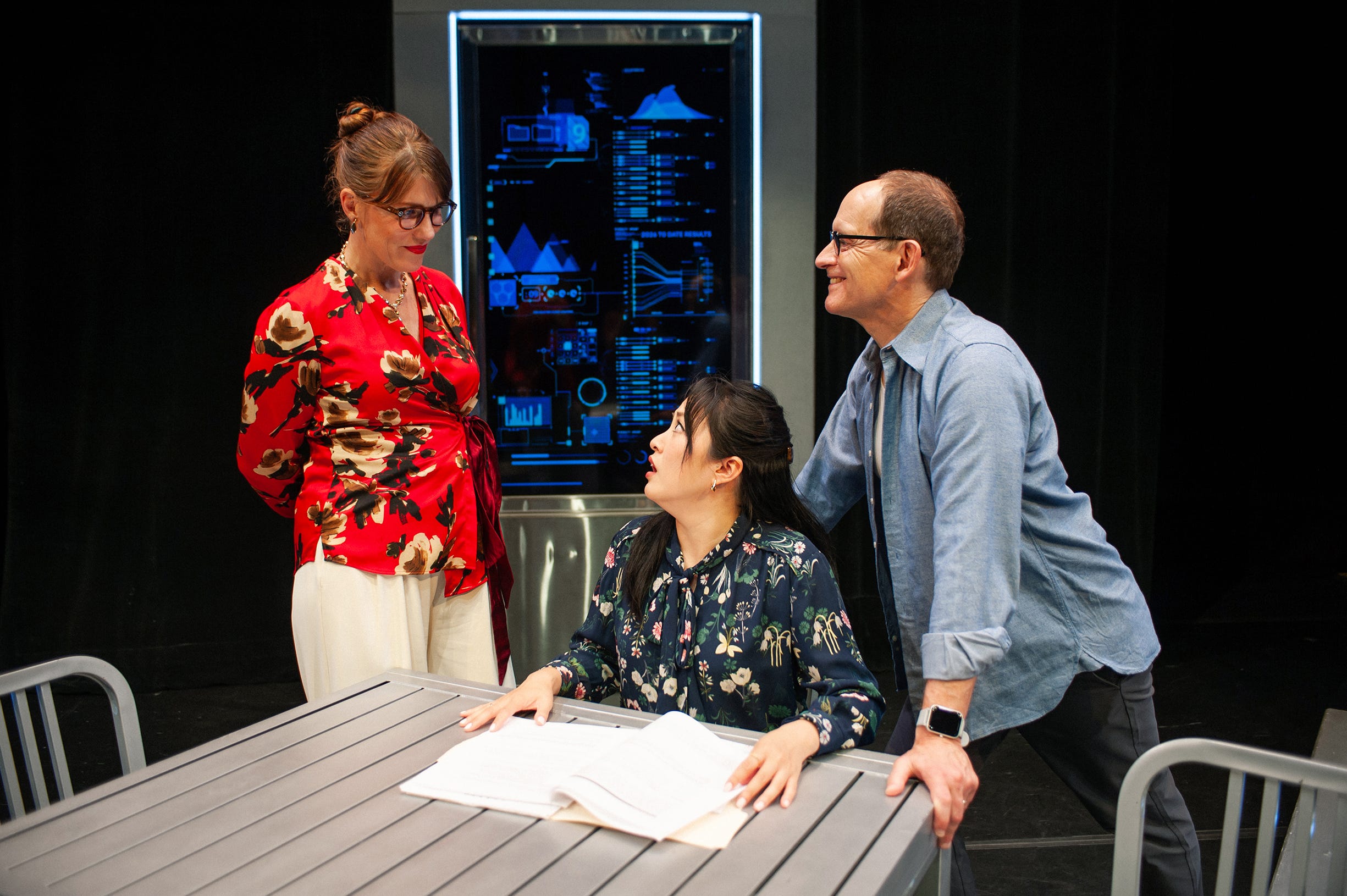
R.O.I. (Return on Investment), now playing in a world premiere production at San Francisco Playhouse, exemplifies the very societal failings it seems to want to critique. Playwright Aaron Loeb sets his sights on the world of venture capital — specifically the biotech sector, in which funders engage in a cutthroat race to be first in supporting medical advances that are possibly dubious and that they themselves don’t entirely understand. In a similar way, R.O.I. bursts onstage, sweaty and winded with effort, clutching a shiny, zeitgeisty trophy aloft, but without much else to show for it. OK, you got your venture-capital yarn into production; now what have you got for the next round of investors?
To describe the plot of R.O.I. is to tick off items on a checklist of fully predictable tropes. Paul Montrose (Anthony Fusco) is the figurehead of a venture capital firm that he founded, he says proudly, because he wanted to “save the world”; he thinks of himself as a liberal do-gooder in spite of his naked avarice and his habit of periodically dropping mildly racist one-liners. He has a sweetly paternal mentor relationship with his associate May Lee (Sharon Shao), who has blossomed under his tutelage in part because, as she happily announces, she has no life outside of work. They get their hands on an earth-shaking asset — a biotech firm that hits a billion-dollar capitalization within its first year — but oh no! What if they have to cut moral corners to hold onto their bonanza?
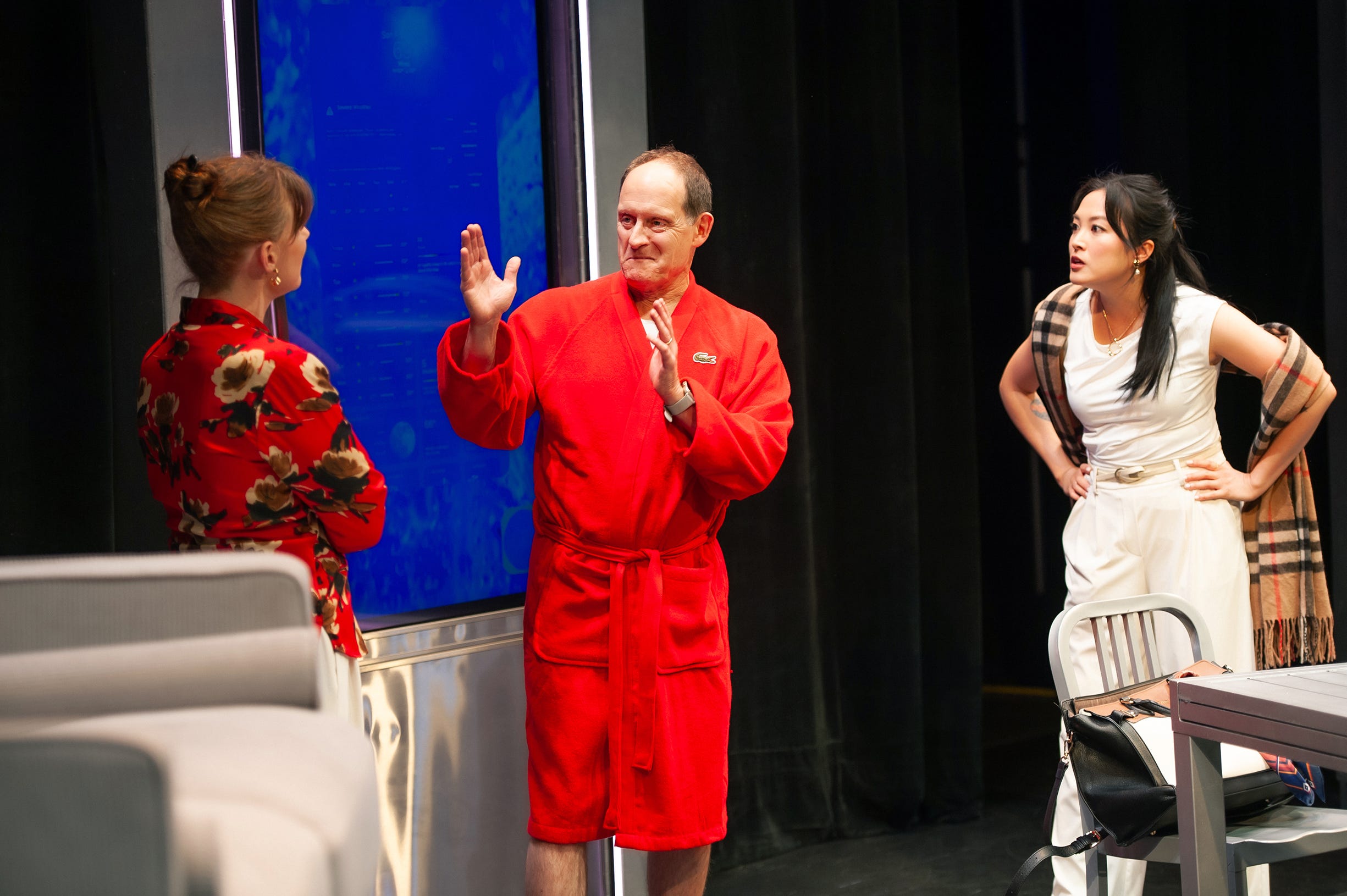
This is the sort of quandary that we’re supposed to find intriguing — and indeed we might, if it were laid out with any ingenuity, insight, or surprise. But Loeb bungles nearly every aspect of the proceedings, on both the level of overall structure and detail. R.O.I. is a 90-minute play in which literally the first hour is devoted to exposition. The characters are drawn with mammoth inconsistencies, creating a persona at the outset that doesn’t always match what they do subsequently.
The chief example of this is Willa McGovern (Lauren English), a prodigy biochemist who claims to have created a cure for cancer — and also Alzheimer’s, and who knows what else. When we first meet her, she’s bumbling her way through an embarrassing funding pitch, dropping her index cards and stumbling over the simplest bit of small talk. (The only conceivable reason May doesn’t reject the project out of hand is that the play would be over within the first 15 minutes.) But once Willa’s startup, Precure, is up and running lucratively, she suddenly transforms into a steely schemer and all-around evildoer. She fulminates against the Chinese and the Jews, and spends as much time curing every disease on the planet as making sure no one but white folks can have access to her technology. (I suspect there’s some veiled portraiture of Elon Musk here, but the parallels are too murky to make out.)
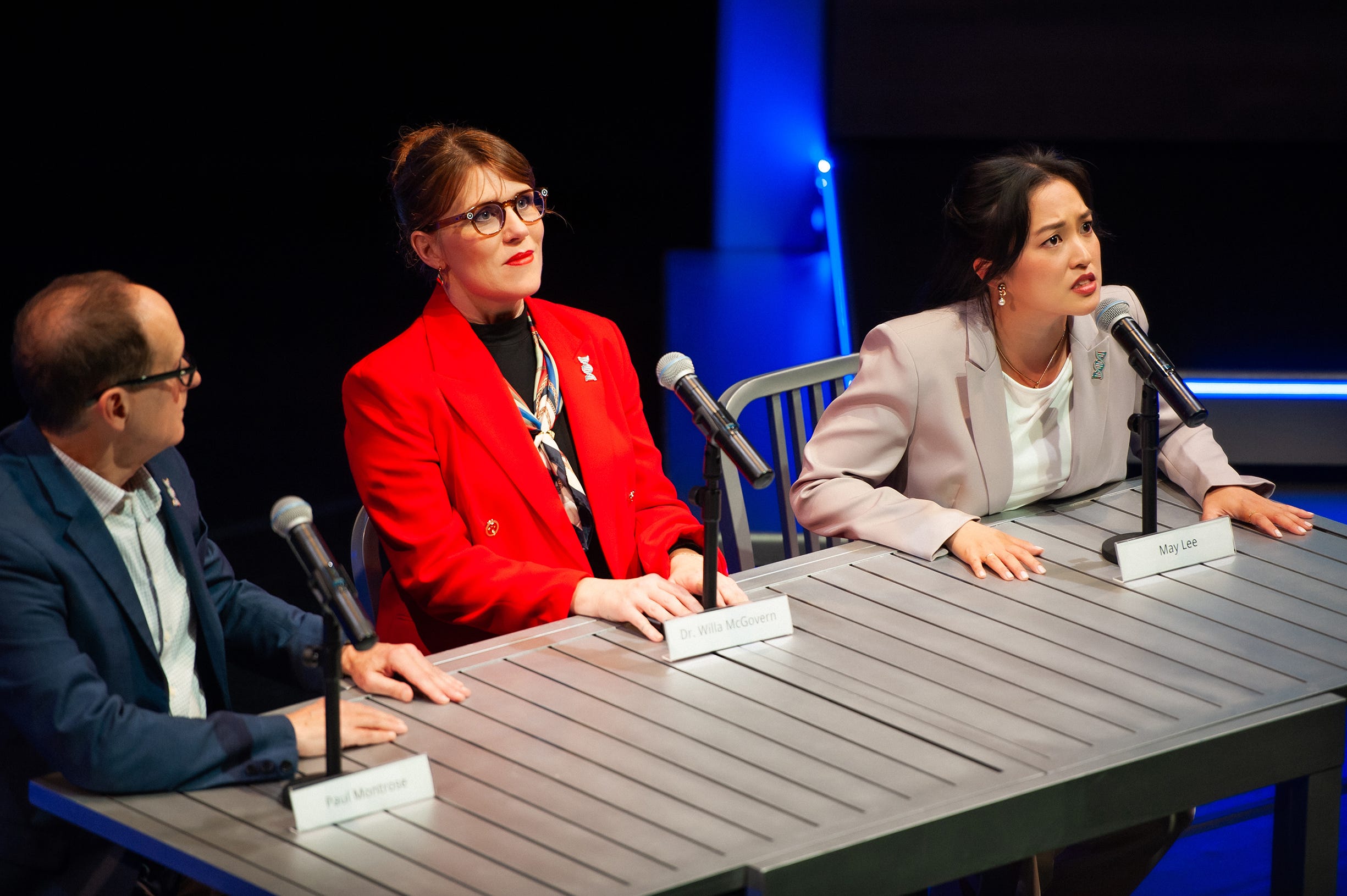
Are Precure’s advances genuine? Loeb is slightly cagey on the subject, and for good reason — he’s painted himself into a corner with his extravagant premise. If McGovern is a fraud, then R.O.I. simply becomes a rehash of the now-familiar Elizabeth Holmes-Theranos story. But if the achievement is genuine — if McGovern has in fact wiped out worldwide disease (single-handedly!) — then the venture capital fund backing her project is surely the single least interesting fact about the entire undertaking. Who cares about a couple of Sand Hill Roaders if the global medical landscape is being transformed?
The latter third of the play descends into some Machiavellian tit-for-tat that is both tedious and impossible to follow (“We’ll sell off our holdings after the third round of funding!” and “Ha-ha! I’ve been taping this entire conversation!” — that kind of stuff). There’s a climax of sorts, in which one of the characters has to make a moral decision that makes no sense even on the play’s own premises, and a genuinely moving final tableau that has almost nothing to do with anything that’s come before. But I’d sold off every share of interest or commitment long before.
R.O.I. (Return on Investment): San Francisco Playhouse, through Sept. 5. www.sfplayhouse.org.
Elsewhere:
Lily Janiak, San Francisco Chronicle: “Loeb’s script, directed by Jonathan Moscone, could have just been another enjoyable but mean-spirited, one-dimensional workplace dramedy in thrall to the profit motive…But one of the joys and surprises of “R.O.I.” is that just when it could have been merely an excellent specimen of that sort of play, it leaps much, much farther.”
AJ Jaffari, Broadway World: “Without giving too much away, ROI unfolds with the pacing and intrigue of a great sci-fi Netflix miniseries. What begins in the seemingly corporate world of venture capitalism gradually expands into something far more complicated, raising questions about power, responsibility, ethics, and who ultimately pays the price for progress.”
Roman carnival
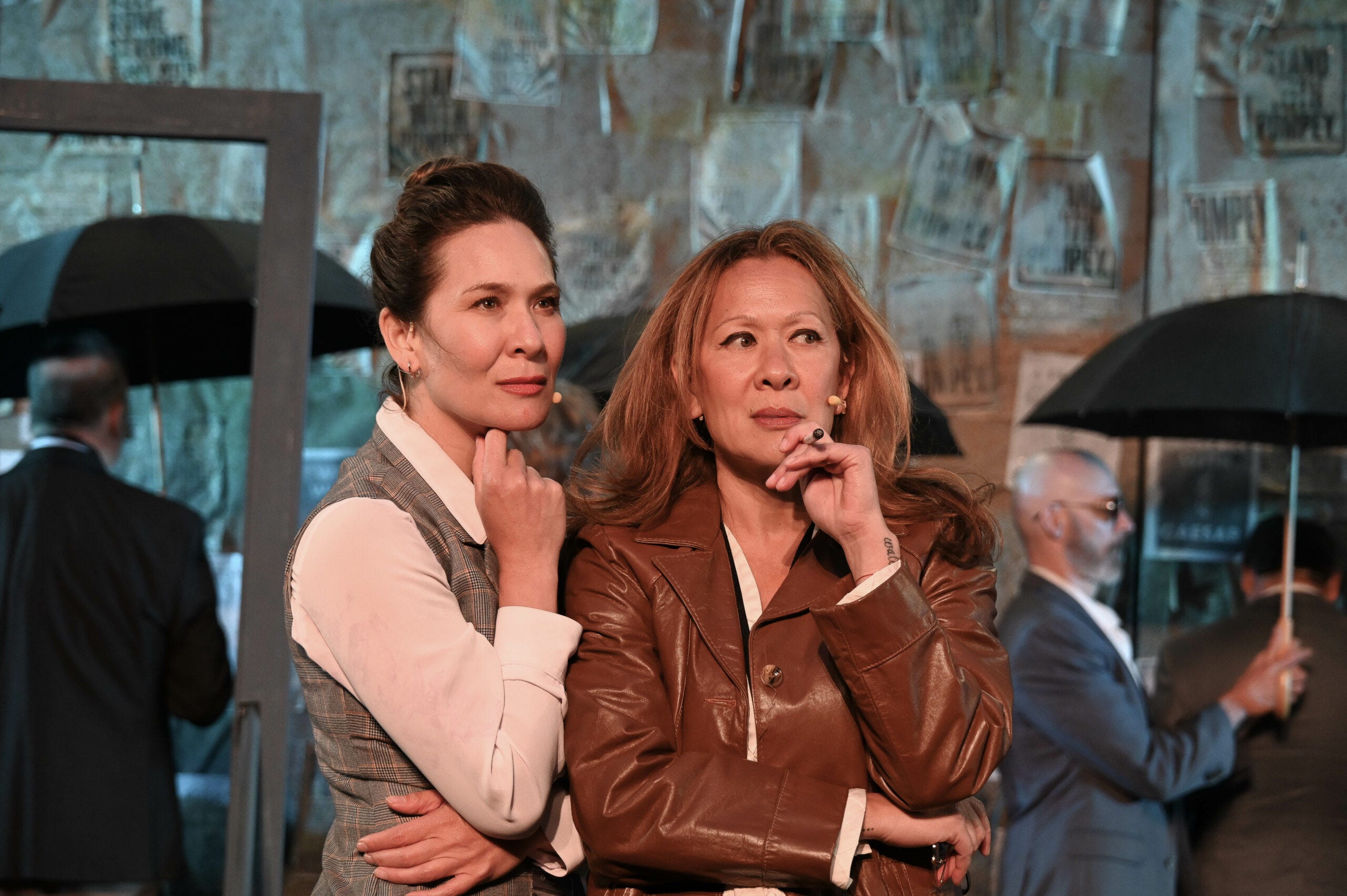
People often say that Shakespeare is hard to understand on the stage, and there’s some truth to this. Generally it’s a truism about the language; unless you have actors with a deep, instinctual command of Elizabethan syntax and prosody (which is far rarer than one might suppose or wish) the words can turn into a jumble.
But sometimes the perplexity is more elemental. It amounts to watching a play and thinking, quite frequently, wait, what the fuck is actually going on here? That’s what happens with the Julius Caesar currently playing at the Marin Shakespeare Company, where director Jon Tracy has “re-imagined” Shakespeare’s original in ways that are both sweeping and specific, and produced a sort of theatrical fantasia on themes by the Bard. It’s as if he’s put Julius Caesar into the Calvin and Hobbes transmogrifier and staged the results.

It’s difficult to say how well the production succeeds without knowing more about Tracy’s intentions, and unfortunately those intentions are difficult to infer from anything on the stage. The setting is both mythic and high-modern, which is to say that it’s hard to pin down. (The program tells us the setting is after World War II but before the digital age — which is odd given how much time the characters spend swiping electronic key cards or listening to music through earbuds.) The offstage screams of dissidents being dragged away locates us in some kind of political dystopia, but there’s not much to suggest that Tracy is interested in the overall themes of power and conflict. He engages in some very ostentatious gender shifts — in particular making Brutus and Cassius sisters and stocking the Senate with a preponderance of women — but there’s nothing feminist or gender-themed about his reading. Also, Shelley’s “Ozymandias” gets smuggled in.
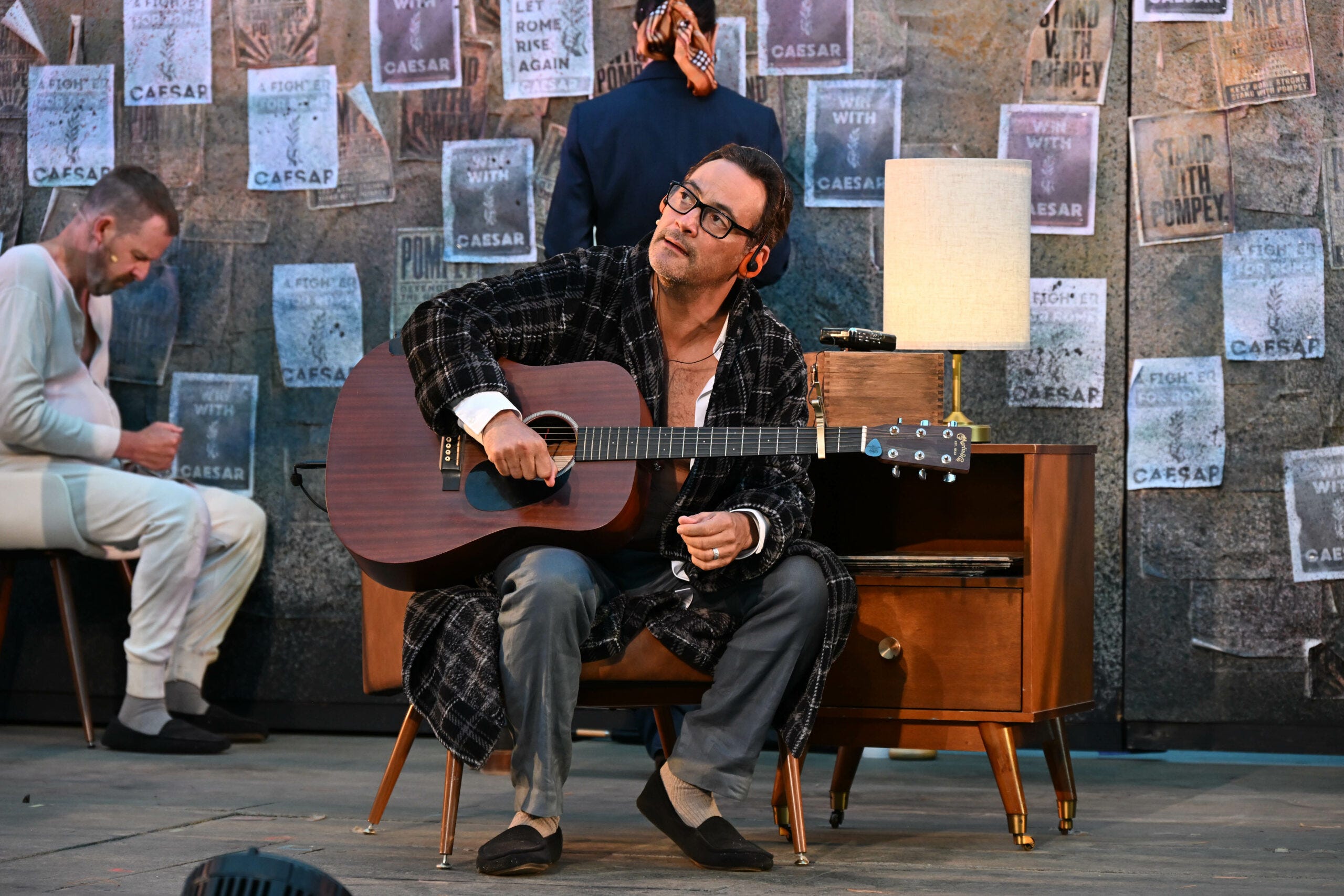
But perhaps the production’s strangest and most obstreperous decision is to suggest that the cause of Caesar’s downfall was not his ambition or his military prowess or his political ineptitude, but rather his unquenchable devotion to the cheesiest pop hits of the 1970s and ’80s. I’m not joking. When we first meet him, he has no interest in the civic turmoil that surrounds him; he’s too intent on learning to strum and sing Bread’s “Make It With You.” Worse yet, the appearance of Caesar’s ghost amid the warfare of the play’s second act becomes, in Tracy’s staging, an endless, quavering, overamplified rendition of Whitney Houston’s “Greatest Love of All.” Honestly, your guess is as good as mine.
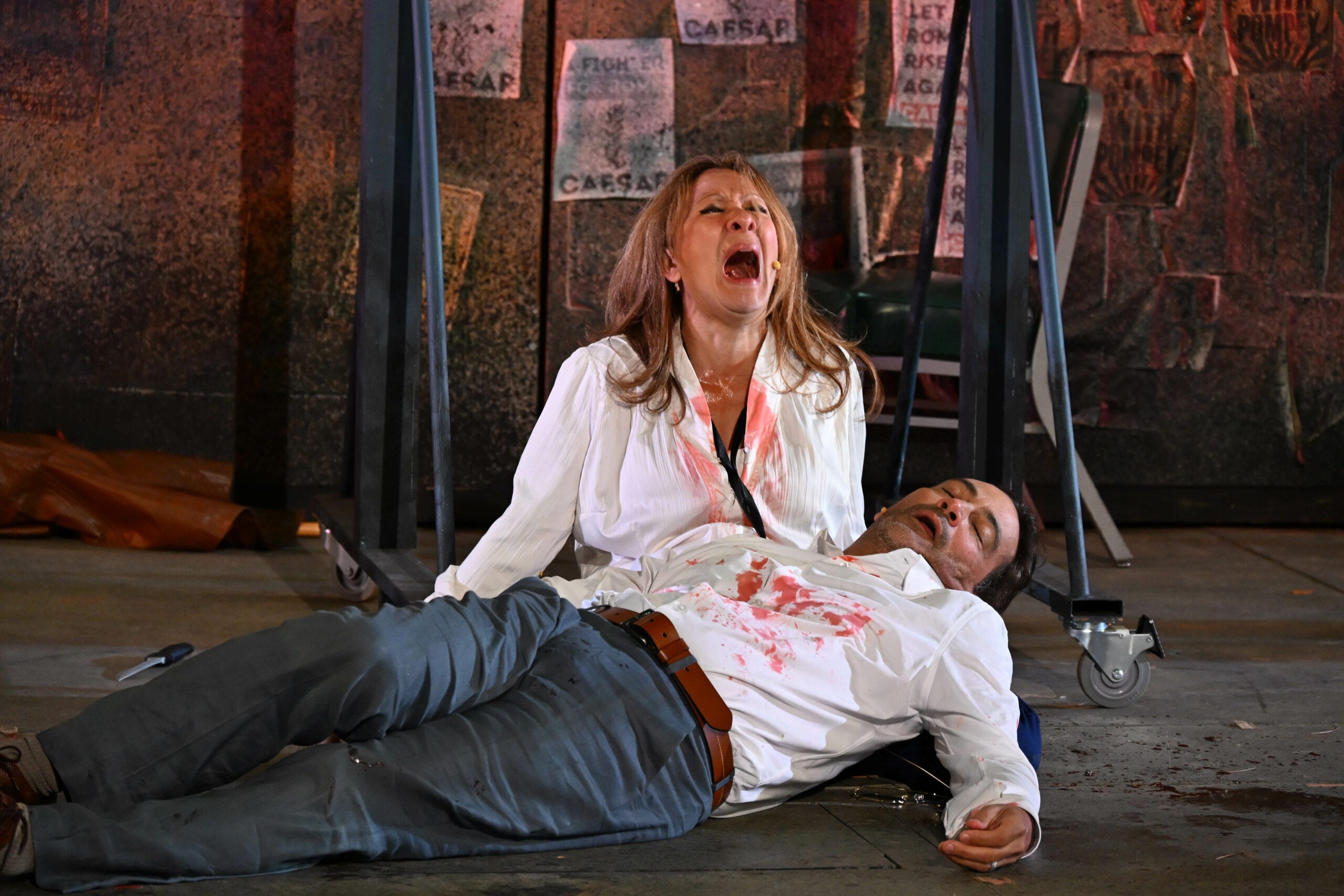
Here and there, the lightning flashes and a moment of theatrical splendor breaks through. To sit in the open-air benches of San Rafael’s Forest Meadows Amphitheatre during the funeral scene, for example, with the succession of orators in front of you and the fickle throng of Roman onlookers behind you, is a vivid and scary experience; each new shift in the crowd’s sentiments registers as a threat. The sisters Bridgette and Charisse Loriaux as Brutus and Cassius, respectively, give the characters a bond that is wonderfully loving and prickly. Steve Price gives a superbly mournful performance as Port (the gender-swapped version of Brutus’s wife Portia), an alcohol-soaked, overlooked retired general. Dave Garrett makes a deftly uproarious Casca. And you have to applaud Tracy’s decision to collapse Shakespeare’s dozens of indistinguishable Romans to four or five all-purpose stick figures.
But what is any of it in service of? Julius Caesar has plenty to tell us about morality and power, about when it’s appropriate to be a loyal follower and when the time comes to rise up even against beloved and revered allies. Some of these issues, as you may have noticed, feel particularly urgent at the current moment. None of them comes into focus here.
Julius Caesar: Marin Shakespeare Company, through Sept. 13. www.marinshakespeare.org.
Elsewhere:
Lily Janiak, San Francisco Chronicle: “…Tracy [has] a second-half problem common in Shakespeare plays. Much of the best stuff — the life-defining choices, the most suspenseful moments, the juiciest language — is front-loaded, leaving the final acts as a series of boxes to be ticked…Here, direction often feels like a term paper written on an all-nighter, based on CliffsNotes.”
Barry Willis, Marin Independent Journal: “A passionate orgy of high-level dramatic arts, this Julius Caesar has moved into the No. 1 spot for this reviewer. Marin Shakes takes the tale into another realm entirely, one devastating and profound. Allusions to current political realities are intentional and appropriate. Prepare to be astounded.”
Corey Finnegan, Theatrius: “In Act I, [Nina] Ball’s purposefully claustrophobic set is populated by actors standing silent as mannequins, representing the invisible masses. Her set design for Act II is positively inspired, evoking a Rome descended into chaos and civil war. For theater-lovers, the play’s sharp acting and arresting design are reason enough to see the show.”
Coming attraction

Claude & Marcel, an opera-in-progress by composer Alyssa Weinberg and librettist Stephanie Fleischmann, isn’t due for its commissioned world premiere until next summer from West Edge Opera. But even from this early vantage point it looks very promising indeed.
The company offered a preview of the opera on Sunday, an unstaged orchestral run-through of the first of two projected acts conducted by music director Jonathan Khuner. The cast, led by mezzo-soprano Nikola Printz and sopranos Laura Bohn and Angela Yam, was superb. Obviously, it would be neither appropriate nor wise to say anything very concrete about the piece at this point; who knows what changes might come to pass between now and 2027? Still, there was enough there to make me look forward to the final product.
To begin with, the subject matter is scintillating. The opera is a joint musical biography of the Surrealist artists Claude Cahun (née Lucy Schwob) and Marcel Moore (née Suzanne Alberte Malherbe), who fell early into the orbit of such figures as André Breton. They moved from their native Nantes to Paris, hoping, as one handsome line in the libretto puts it, to “make waves in the Surrealist sea of mostly men.” (The most surrealist and delightful detail of their lives, in my view, is that well after they had become lovers and life partners, their widowed parents married one another, making them, suddenly, also stepsisters.) They moved to the Isle of Jersey in 1937, and when the Germans invaded three years later, helped disseminate anti-Nazi propaganda among the troops.

The first act of Weinberg’s score as it currently stands is studded with inventive strokes to conjure up their journey as the libretto leapfrogs unpredictably through their decades together. A singer’s breath, passed through an electronic looping device, evokes the sea surrounding their island home. The rusty, elusive scraping of a single violin, at once recognizable and eerily otherworldly, conjures up the women’s esthetic in which, as Cahun sings, “we bend the real.” Most affecting is the duet vocal style Weinberg has devised for the two women; they sing in a close-knit parallelism that is neither unison nor harmonious thirds, but something tenderly, abrasively, in between. I’m eager to see how the final product shapes up.
Cryptic clue of the week
From Out of Left Field #334 by Henri Picciotto and me, sent to subscribers last Thursday:
Tell me the latest about team’s blunder (7)
Last week’s clue:
Very best illustrator of Hanukkah scenes? (3-6)
Solution: TOP-DRAWER
Very best: definition
illustrator of Hanukkah scenes?: punny second definition
Coming up
• Sacred Voices: The 40-voice choir, populated with singers from Roman and Vatican choirs, is making its first U.S. tour. The program features music associated with the Sistine Chapel, by Renaissance composers including Giovanni Pierluigi da Palestrina. Grace Cathedral, Aug. 20. www.gracecathedral.org.