
Girls gone random
Playwright Eisa Davis’s scattershot premiere at A.C.T. set young musicians in awkward counterpoint

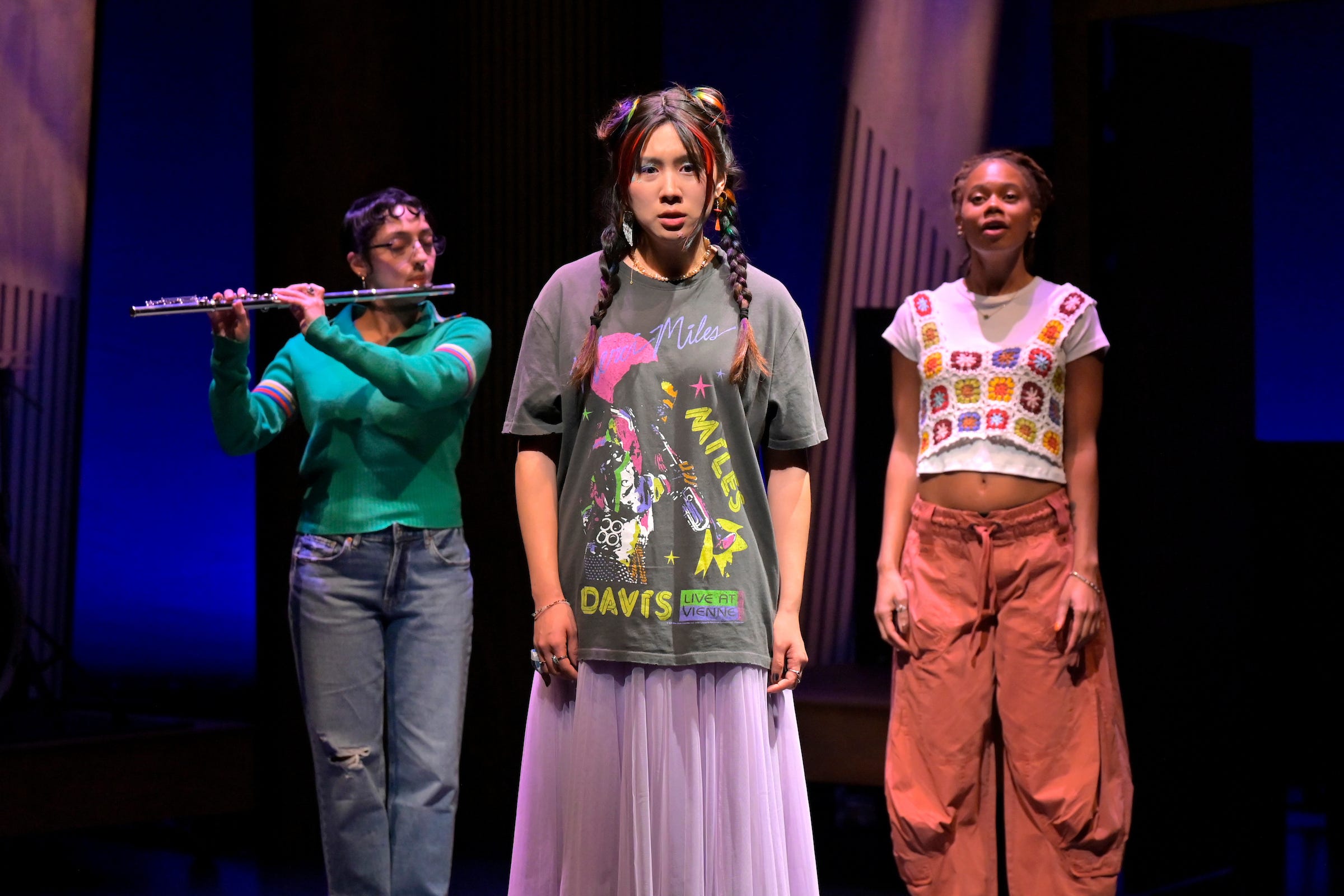
//: Girls ://: Chance ://: Music ://, Eisa Davis’s new chamber play at A.C.T. about teenage girls in a Berkeley summer program for musicians, opens with an exhilarating air of promise. Before the play begins for real, a dozen preselected audience volunteers come to the stage to randomly pick out one note each on a piano keyboard. Voilà — a 12-tone row, randomly whipped up on the spot! Three of the show’s four gifted young actors memorize four notes apiece while their castmate coaches them; they kick the melodic cells around, scatting and developing mnemonics for these arbitrary musical nuggets; then they get into character and the play gets underway.
Already in these few moments, Davis — whose glowing, mysterious Bulrusher lit up the stage of Berkeley Rep a few seasons back and then went on to become an opera with a score by composer Nathaniel Stookey — makes the audience a number of tantalizing promises. The tone row whose birth we’ve just witnessed will thread its way through the ensuing performance, something like the way a Schoenbergian tone row acts as both structural underpinning and thematic material in a piece of music. The effort the actors have expended in learning it will be put to use somehow. And because any given performance is predicated on this ad hoc construction, the present evening will be different from others, with an improvisatory freedom somewhere between John Cage and Nichols and May.
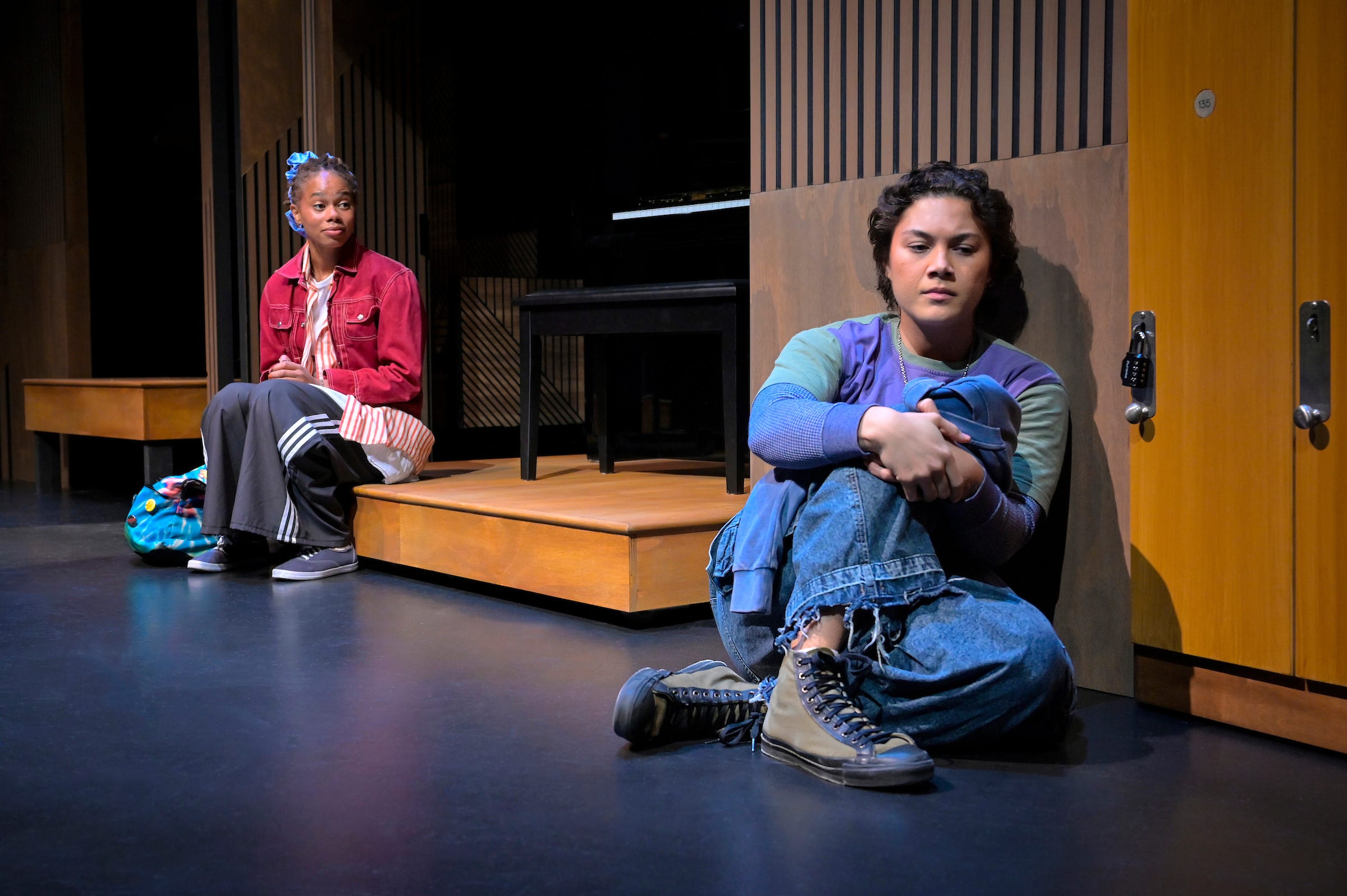
Those are good promises, and for perhaps the first half of its two-hour runtime, //: Girls ://: Chance ://: Music :// carries you along on the conviction that any minute now, everything’s going to come together somehow. In the meantime, there are momentary pleasures to tide you over. The performers are a delight to spend time with, and in the hands of director Pam McKinnon (in her final project before stepping down as the company’s artistic director) the characters come into just enough focus that they don’t stop seeming like sweet, confused adolescents: Hillary Fisher as the anxious chatterbox Fax; Yeena Sung as Rile, a pianist whose efforts to sublimate her rage into music are only partially successful; the drummer Margot (Naomi Latta), whose closed-off sullenness forces everyone else’s emotional life to revolve around her; and Gianna DiGregorio Rivera as Clementine, whose vacuousness is so complete that not even Davis herself can think of any way to make her matter. All four cast members are excellent musicians, which makes the show come off like a less intolerable version of the Broadway smash Stereophonic.
But then, like the air slowly leaking out of a balloon, the play grows increasingly diffuse until it finally collapses in on itself. There are still moments of theatrical magic strewn throughout, including a scene in which Rile discovers the transgressive power of unplugged profanity, and a pivotal group improvisation that unleashes a new spirit of freedom in some of these young characters. It soon becomes clear, however, that Davis hasn’t really made any decisions about why she’s assembled these characters. Family tensions come up, as does the general awkwardness of teen life, but none of that is explored for long enough to make you think, Aha, this is what the play is about. Sometimes the music is treated as a metaphor for something else; sometimes it’s just music. That 12-tone row gets lost somewhere along the way.
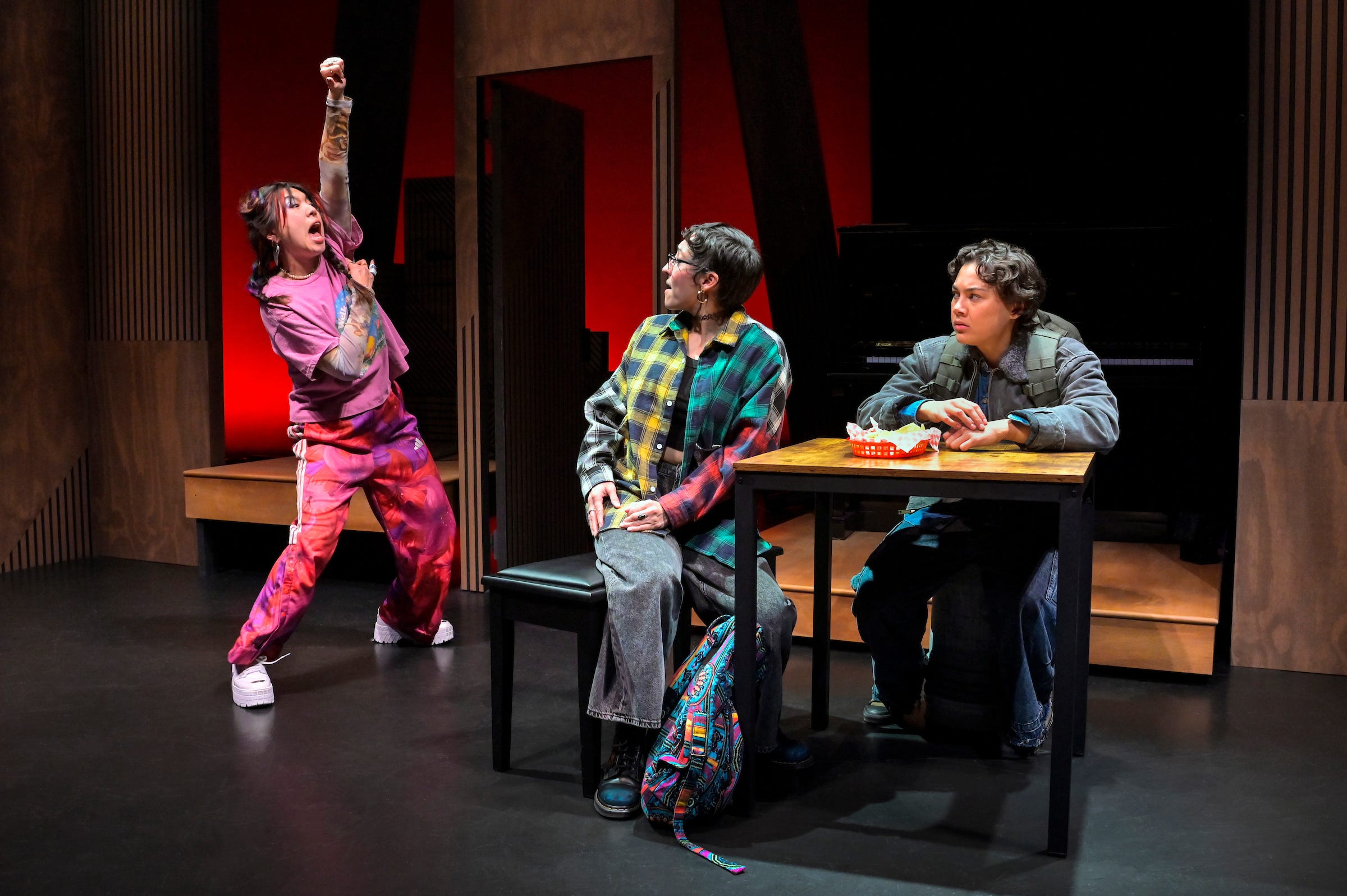
For myself, I was most put off by the bad faith with which Davis explores the tension in music between freedom and adherence to a score. There’s a promising moment when one of the characters sketches out the types of students in the music program: “The classical girls can read music but not improvise; the jazz girls can improvise but not read music.” That is (or could be) a fascinating dichotomy, but it doesn’t actually interest Davis. Instead, she puts both her thumbs down on the scale to make it clear that in her view, only the jazz girls have it right. In an epilogue, she reveals that the girls who can’t improvise wind up drifting away from music, in one case to become an office drone. That’s not theater; it’s a sermon, and a simplistic one at that.
//: Girls ://: Chance ://: Music ://: Strand Theater, through April 19. www.act-sf.org.
Elsewhere:
Lily Janiak, San Francisco Chronicle: “Whole storylines parachute in at the last minute with head-scratching abruptness — much the way the light cues of Russell H. Champa’s design seem to be on a timer independent of the script. Either the play wanted to be about something else the whole time, or it’s still choosing among a grab bag of possibilities.”
Janea Melido, KQED: “In a series of monologues, we get a glimpse into the minds of these girls and their home lives; the play touches on heavy themes like eating disorders, substance abuse, sexuality and homelessness. But as is often the case with teenage girls (I speak from experience), they’re so consumed by their own struggles that they fail to recognize how vastly different their lives are outside this shared space.”
Steve Murray, Broadway World: “This is A.C.T Artistic Director Pam McKinnon’s swan song and it’s a shame she couldn’t whip the show into something with more cohesion and structure, creating an interest in the characters and drawing us into their world.”
Blank verse
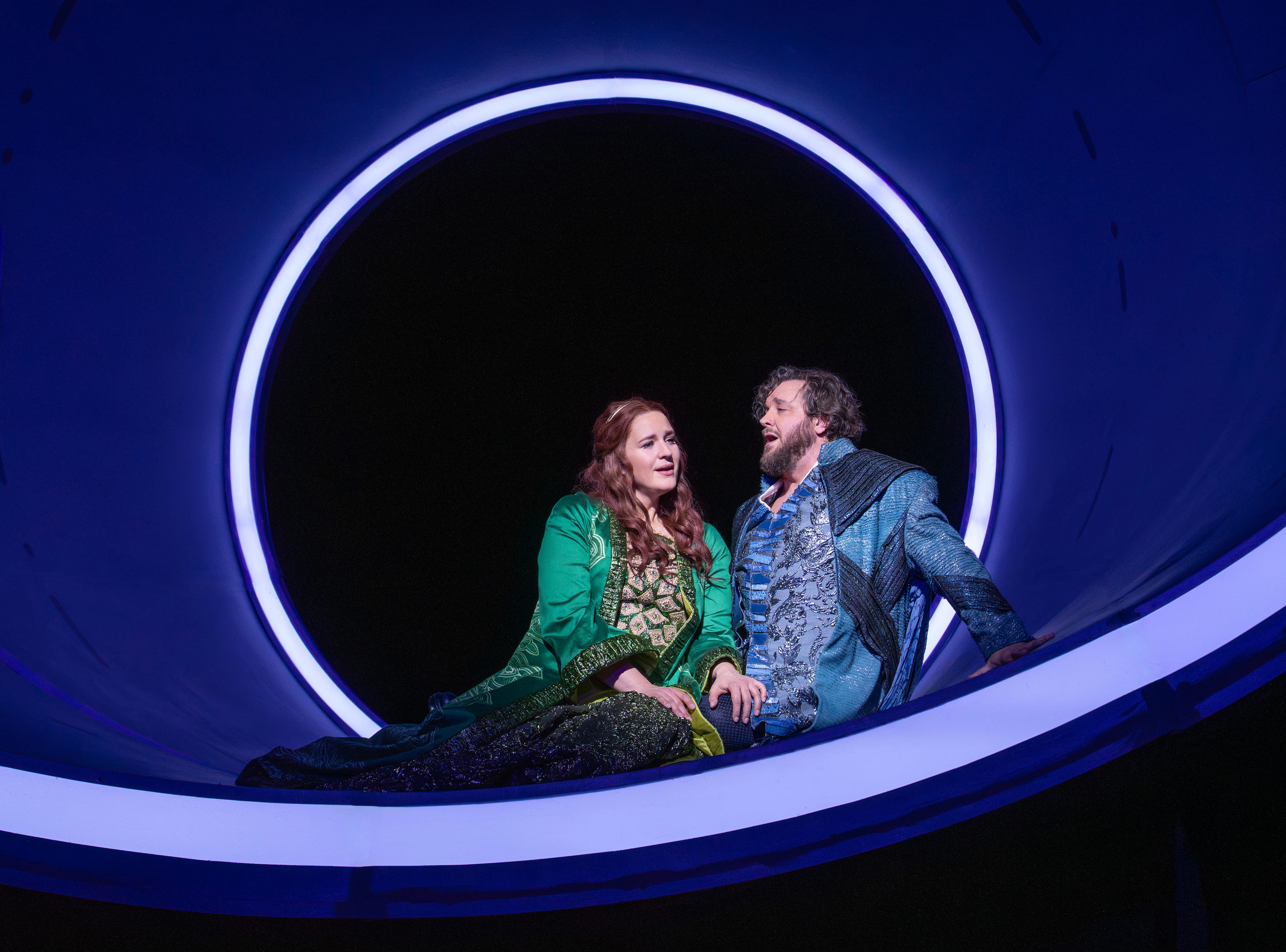
For a test case to assess the proposition that singing is everything in opera, you could scarcely do better than Lise Davidsen’s performance in the Metropolitan Opera’s new production of Tristan und Isolde. The Norwegian soprano boasts a truly magnificent voice, extending from a beautifully dark-hued lower register to vaulting, pinpoint high notes that she unleashed hour after hour without a hint of fatigue. Her sound is ensheathed in plush velvet to the point where every note and phrase seems to have its own little aura; yet everything moves with smooth agility, combining power and flexibility in equal measure. Anyone who wants to proclaim hers the Wagnerian voice of her generation will get no argument from me.
All that was missing from her Isolde, which I saw in a San Francisco movie theater during Saturday’s Met HD simulcast, was…well, everything else. Those gorgeous tones poured forth endlessly, giving voice to no emotion, no psychology, no dramatic presence. Where those qualities should have been, there was instead an impressive blankness. I felt I was acquiring new appreciation for all the expressive riches Wagner had packed into the role just by clocking the absences from Davidsen’s performance — especially in Act 1, where Isolde should conjure up a potent blend of suffering, rage, tenderness, and fierce sardonic wit. If an operatic performance could get Botox, this might be the result.
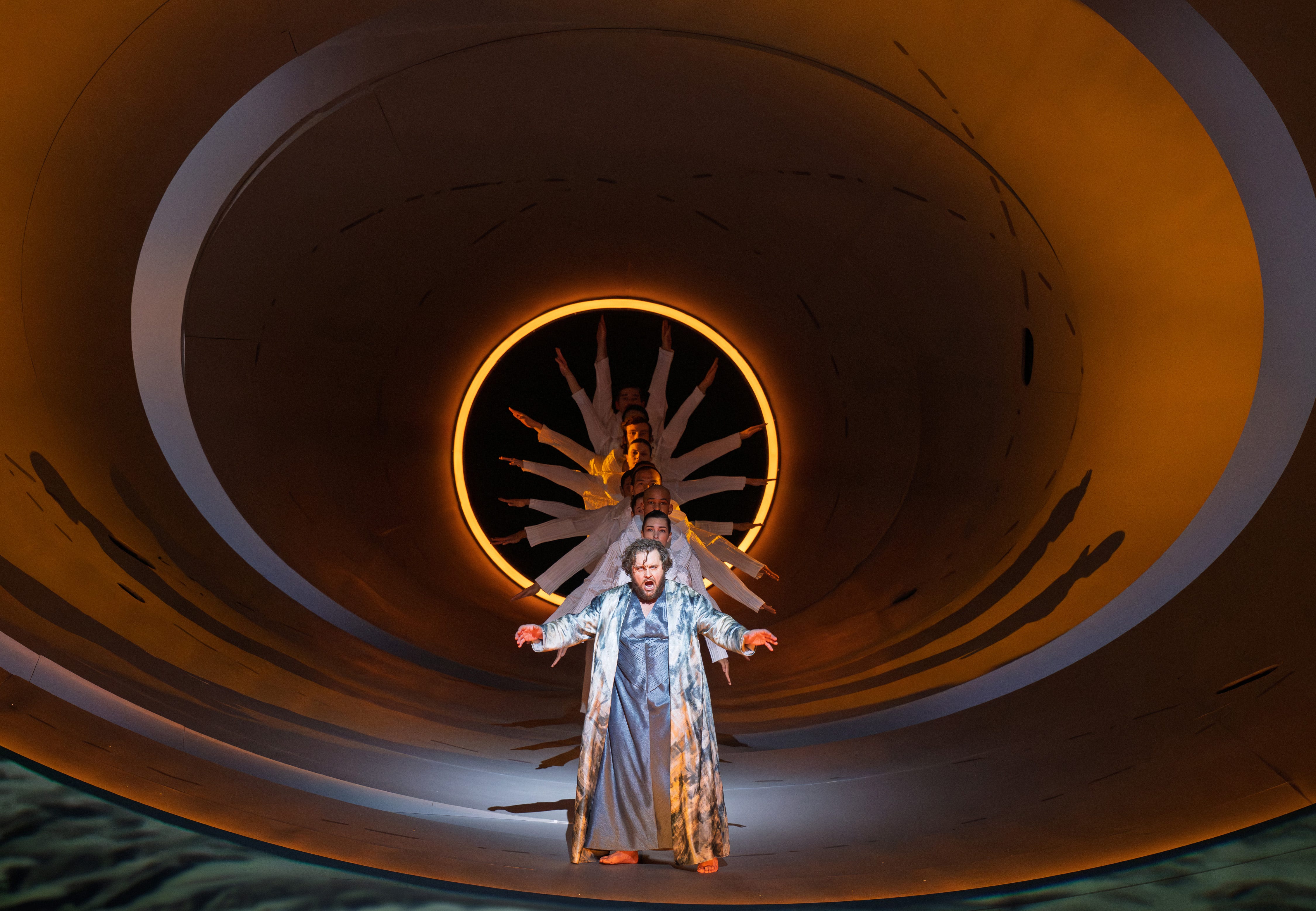
In all other respects, though, this Tristan was every bit as wondrous as early reports had made it out to be. Michael Spyres was a cagey, heroic Tristan, giving voice to the character’s emotional turmoil in Act 1 and forging his way through the Act 3 marathon with impressive stamina. Ryan Speedo Green’s King Marke had gravitas and tenderness, and Tomasz Konieczny put his mellifluous baritone and considerable charisma to good use as Kurwenal. I was especially taken with Ekaterina Gubanova’s peppery, sharp-edged Brangäne, a reading that made the character feel more vivacious than most. Yannick Nézet-Séguin’s conducting was well-judged throughout, in both tempo and temperature.
From everything I could tell, I’m inclined to believe that director Yuval Sharon’s new production is some kind of conceptual masterpiece. To the standard Wagnerian dualities of day/night and life/death, he adds one that we might call “this life/the other life,” which takes on physical form in designer Es Devlin’s majestic two-tier set. The drama takes place both here on Earth and also above it, in a separate, radiant sphere where Wagner parks his Schopenhauerian transcendencies. The parallelism between the two realms is effected with two Tristans and two Isoldes (in each case, to quote Agnès Varda, one sings, the other doesn’t). And at the end, the two domains are tied together with a gorgeous directorial intervention that has probably left the traditionalists spitting mad but that seems to me to serve the story perfectly.
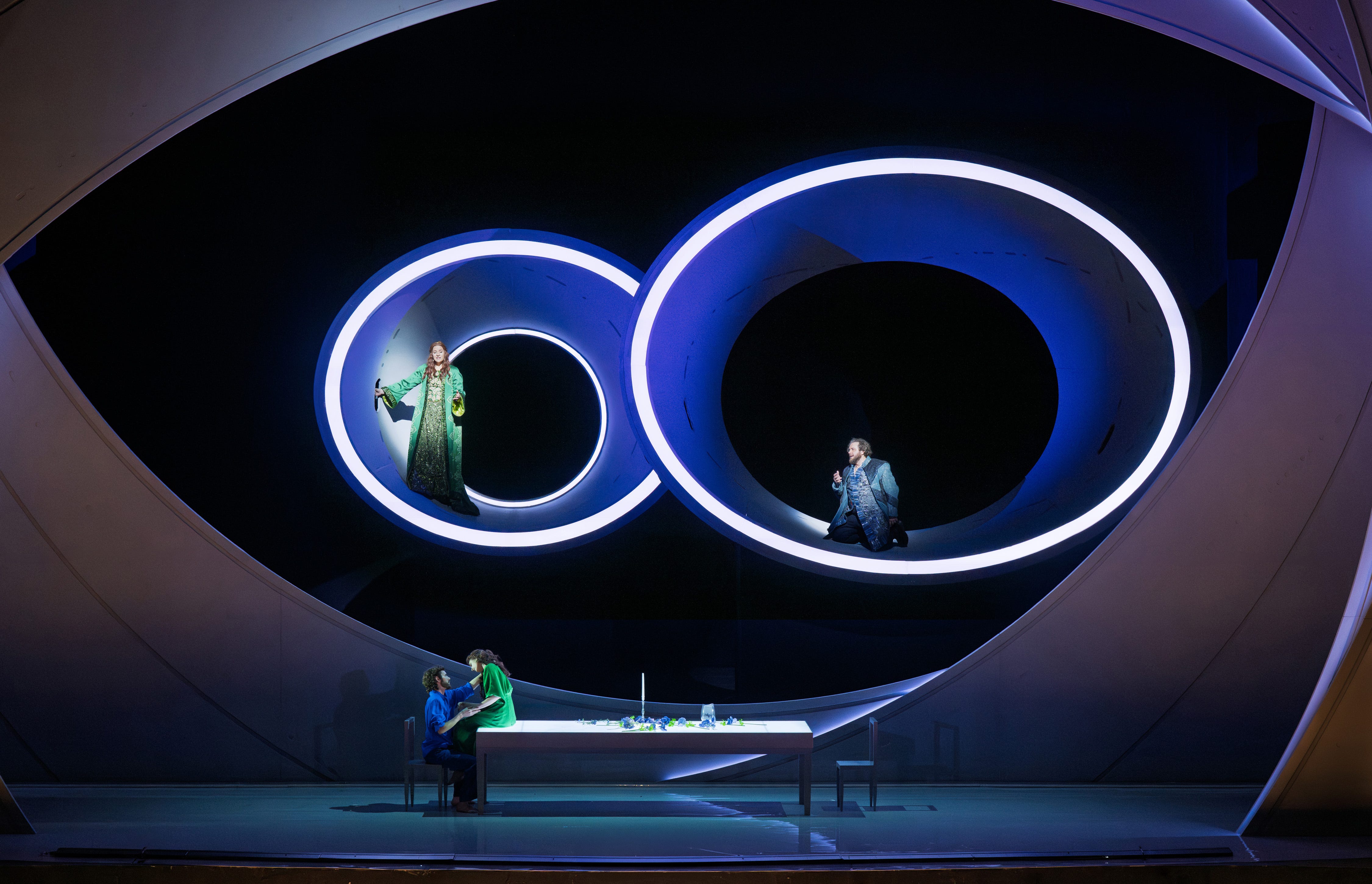
Unfortunately, this is a production fundamentally at odds with the world of Met HD. Why do we love these cinematic streams (aside from the fact that many of us do not live in New York)? Because of the camera’s ability to bring us right in close to the action, so we can observe the work of the singers in intimate detail. But right up close is exactly where we don’t want to be for Sharon’s Tristan production. Every time the camera comes in tight on one of the performers, we lose our sense of the set’s overall architecture — which in this case was critical. Often the camera would pull back to reveal something that had been happening elsewhere on stage, outside the movie audience’s view. So my take on the staging is provisional at best. I think you had to be there.
Elsewhere:
Alex Ross, The New Yorker: “The Met’s latest production, under the direction of Yuval Sharon, is stronger on the philosophical than the psychological…He sees Tristan and Isolde not as isolated flesh-and-blood characters but as archetypes who recur across tellings and retellings of the legend, from medieval times to the present.”
Joshua Barone, New York Times: “Davidsen, a generational artist bound for the pantheon of dramatic sopranos, is entering a new, mature phase of her career that will soon lead to the Wagnerian summit of Brünnhilde in the Ring. And Sharon, a great hope among directors in the United States, is making his house debut with an audience-friendly staging that holds innovation and clarity in equal measure.”
Justin Davidson, New York Magazine: “The opening night of the Metropolitan Opera’s new Tristan und Isolde was one of those great nights at the opera, the kind that will have people arguing what shone most: the confident complexity of Yuval Sharon’s staging, Lise Davidsen’s indelible Isolde, her chemistry with tenor Michael Spyres, or the sensuous discipline of the orchestra. The answer, of course, is all of the above.”
Christopher Corwin, Parterre: “So many head-scratching moments occurred that my scalp was raw by the opera’s serene final moments. The photos the Met released before the premiere whetted my appetite, but the production’s sometimes striking images did not add up to a satisfying spectacle.”
Two by two by two
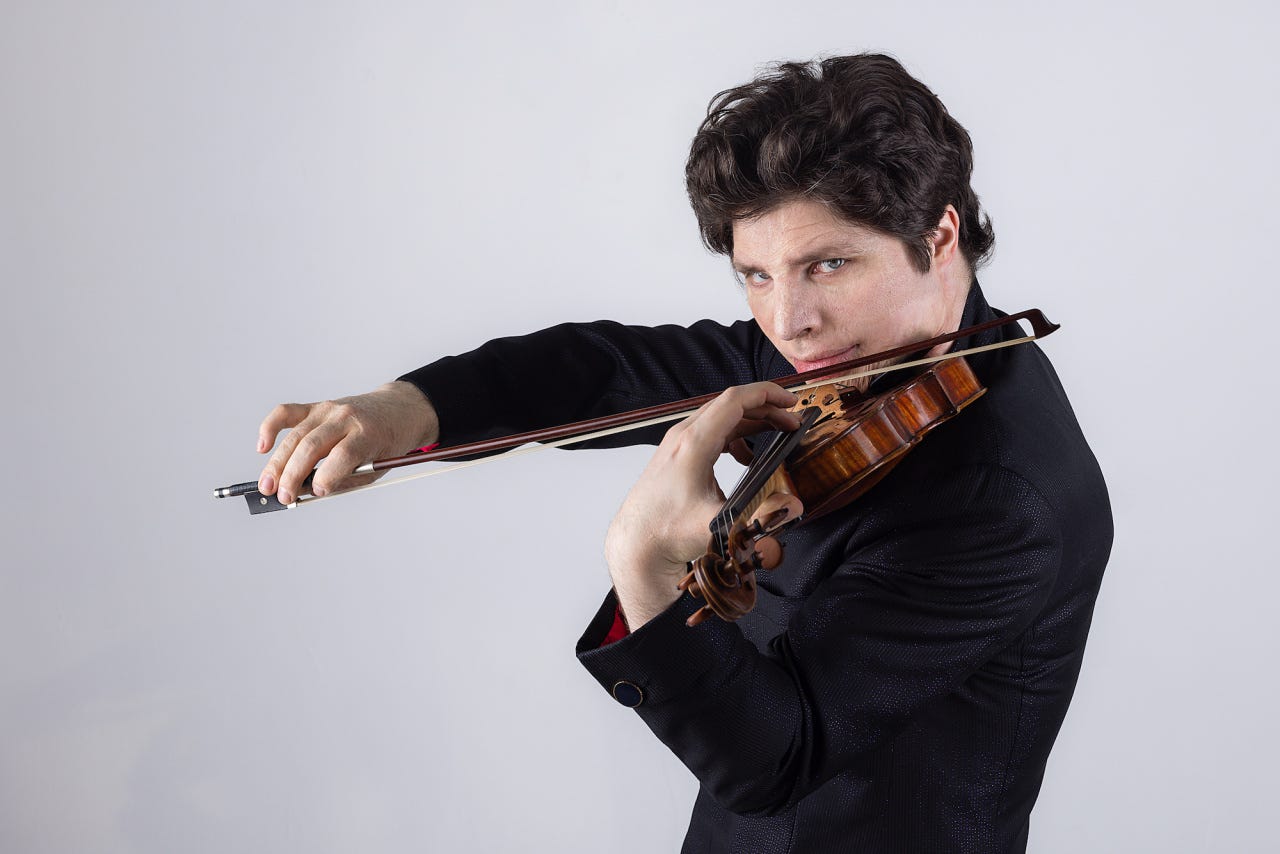
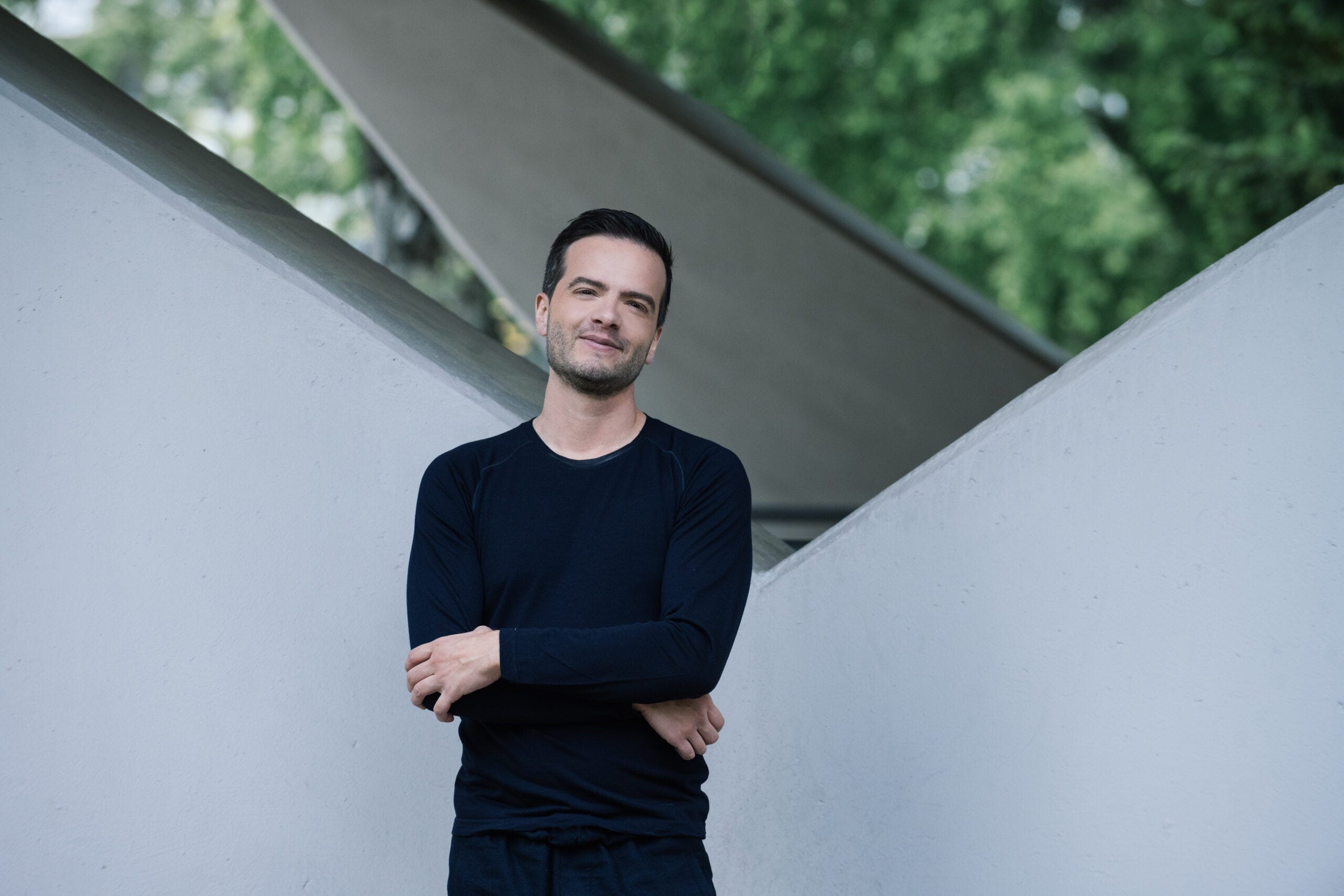
In addition to the lithe and elegant musicianship on display, Friday night’s superb recital by violinist Augustin Hadelich and pianist Francesco Piemontesi, presented in Herbst Theatre by San Francisco Performances, included a nifty little programming gimmick that provided some not-quite-explainable pleasure. The recital was built around three big French sonatas, the familiar ones by Debussy and Franck as well as Poulenc’s less well-known 1943 sonata dedicated to the memory of Federico García Lorca. Each of those, in turn, was preceded by a brief musical amuse-bouche, with the sonata following without a pause or even an acknowledgment that anything out of the ordinary had happened.
The choice of these micropreludes was as idiosyncratic as the practice itself; in other words, I’m at a loss to guess how these pairings were arrived at. The Debussy was heralded by Piemontesi’s arrangement of a bit of hymnody by the 17th-century organist Nicolas de Grigny, while Franck’s escort to this musical prom was the shimmery, still-voiced Tre Pezzi of the great centenarian György Kurtág. Poulenc’s sonata is a gusty, grief-driven affair (the last of its three movements bears the wonderful tempo marking Presto tragico) in which a quick, sneaky quotation from the Tchaikovsky Violin Concerto is only one of many weirdnesses on display; perhaps weirdness was all the excuse the artists needed to bring in Rameau as this piece’s appetizer.
Still, if the specific connections were obscure, the recital’s general shape was irresistibly charming — as was the sumptuous playing from both collaborators. Hadelich brought a certain weightless, aerodynamic quality to the Debussy that was deftly balanced by Piemontesi’s more structurally solid contributions; the Poulenc, in contrast, sounded aptly fierce and emphatic. All these attributes and more came together in a perfectly honed account of the Franck, one which seemed to teeter throughout between gentleness and power while avoiding either extreme.
Elsewhere:
Rebecca Wishnia, SFCV: “You’d be forgiven for playing this music lightly. Debussy cribbed bravura passages from Andalusian Romani music; Poulenc dipped into salon music. But on the other hand, each work was written in wartime. Military marches echo in Poulenc’s square rhythms, and even Debussy’s lyrical clouds have their corners.”
Cryptic clue of the week
From Out of Left Field #312 by Henri Picciotto and me, sent to subscribers last Thursday:
Backup plan: loaner kitchen appliance (7)
Last week’s clue:
Let’s switch the final parts, just in case (4)
Solution: LEST
Let’s: LETS
switch the final parts: straightforward instruction
just in case: definition
Coming up
• Edgar Meyer and Dover Quartet: The bassist and composer, renowned for the fluency and charm with which he blends classical music, bluegrass, jazz, and more, has gotten top billing for this event, which features two of his works including his String Quartet. Just as alluring, though, is the chance to hear the wondrous young Dover Quartet in music by Mozart and Mendelssohn. March 27, Herbst Theatre. www.sfperformances.org.
• Myriad Trio: When you form a chamber ensemble around the instrumentation of Debussy’s Sonata for Flute, Viola, and Harp, that doesn’t mean you actually have to play the piece every time. Flutist Demarre McGill, violist Che-Yen Chen, and harpist Julie Smith Phillips have been busily commissioning new works and arranging old ones to fit the lineup, and the group’s recital program includes classics by Rameau and Beethoven along with recent offerings by the late American composers Jan Bach and Lita Grier. March 28, Presidio Theatre. www.chambermusicsf.org.
• Ava Nazar: The Iranian-American pianist and composer comes to town with a fascinating program devoted to music by Iranian women — a cohort far too rarely heard from. In addition to her own music, she’ll plays works by Niloufar Nourbakhsh (whose work-in-progress Threshold of Brightness stood out triumphantly at West Edge Opera’s recent “Snapshot” showcase), Yassaman Behbahani, Aso Kohzadi, and Nina Barzegar. March 29, Old First Church. www.oldfirstconcerts.org.