
Inner voices
When my gut told me to skip last week’s San Francisco Symphony program, maybe I shoulda listened

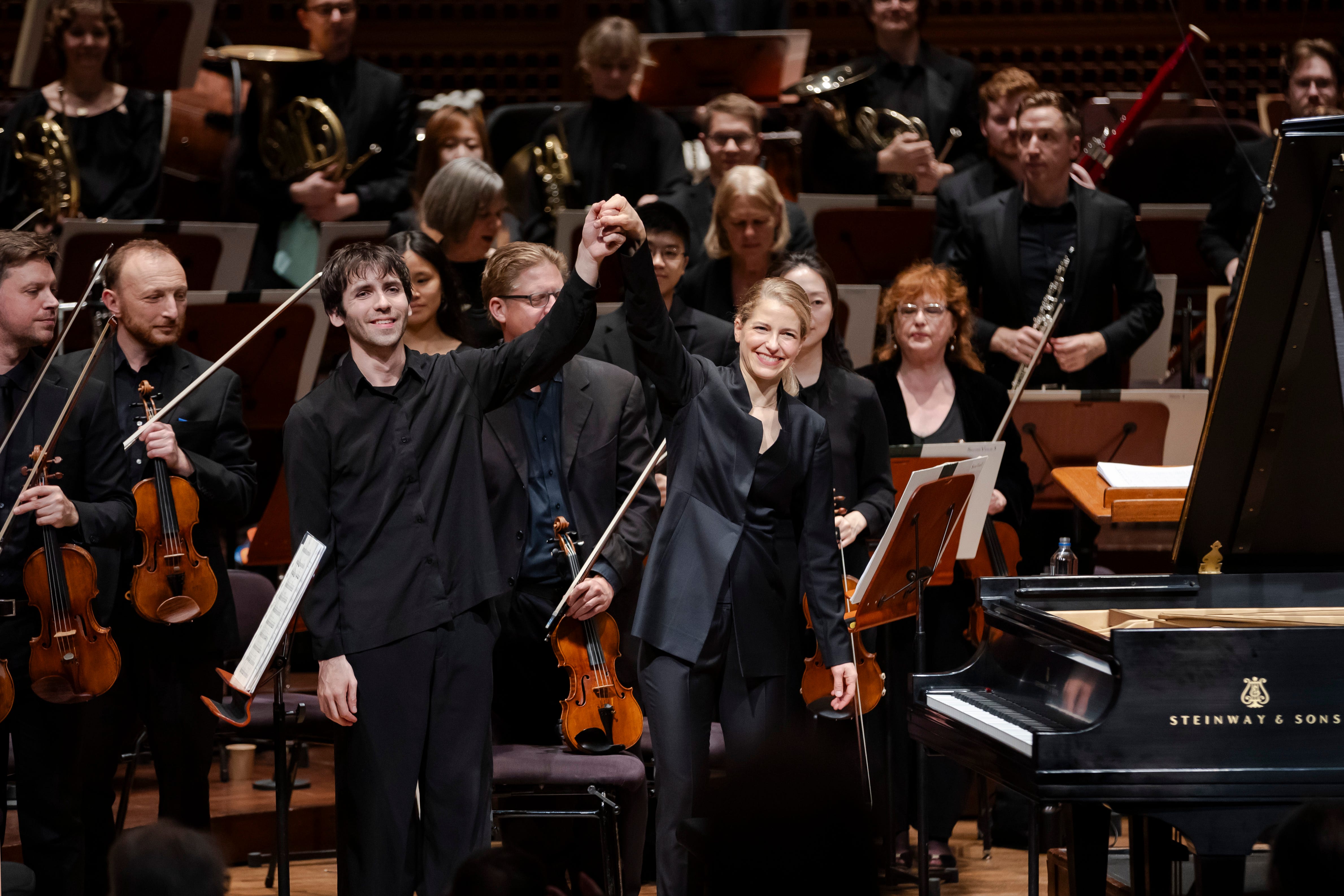
In all candor, I was of two minds about even going to last week’s San Francisco Symphony program. The repertoire (Dvorák, Prokofiev, Sibelius) didn’t feel particularly urgent, and in her three prior appearances in Davies Symphony Hall, guest conductor Karina Canellakis has never quite struck me as someone with deep interpretive thoughts on the orchestral standards.
But the French pianist Alexandre Kantorow was making his Symphony debut in Prokofiev’s Third Concerto, and just a few days earlier, he’d given a solo recital in Washington, D.C., that had filled my social media feeds with effusive praise. In a Facebook post, Philip Kennicott, the Washington Post’s polymathic arts critic (formerly classical music, now art and architecture), extolled Kantorow’s tonal clarity, his thoughtful and imaginative programming, and his “transcendental” keyboard technique. Sounds promising!
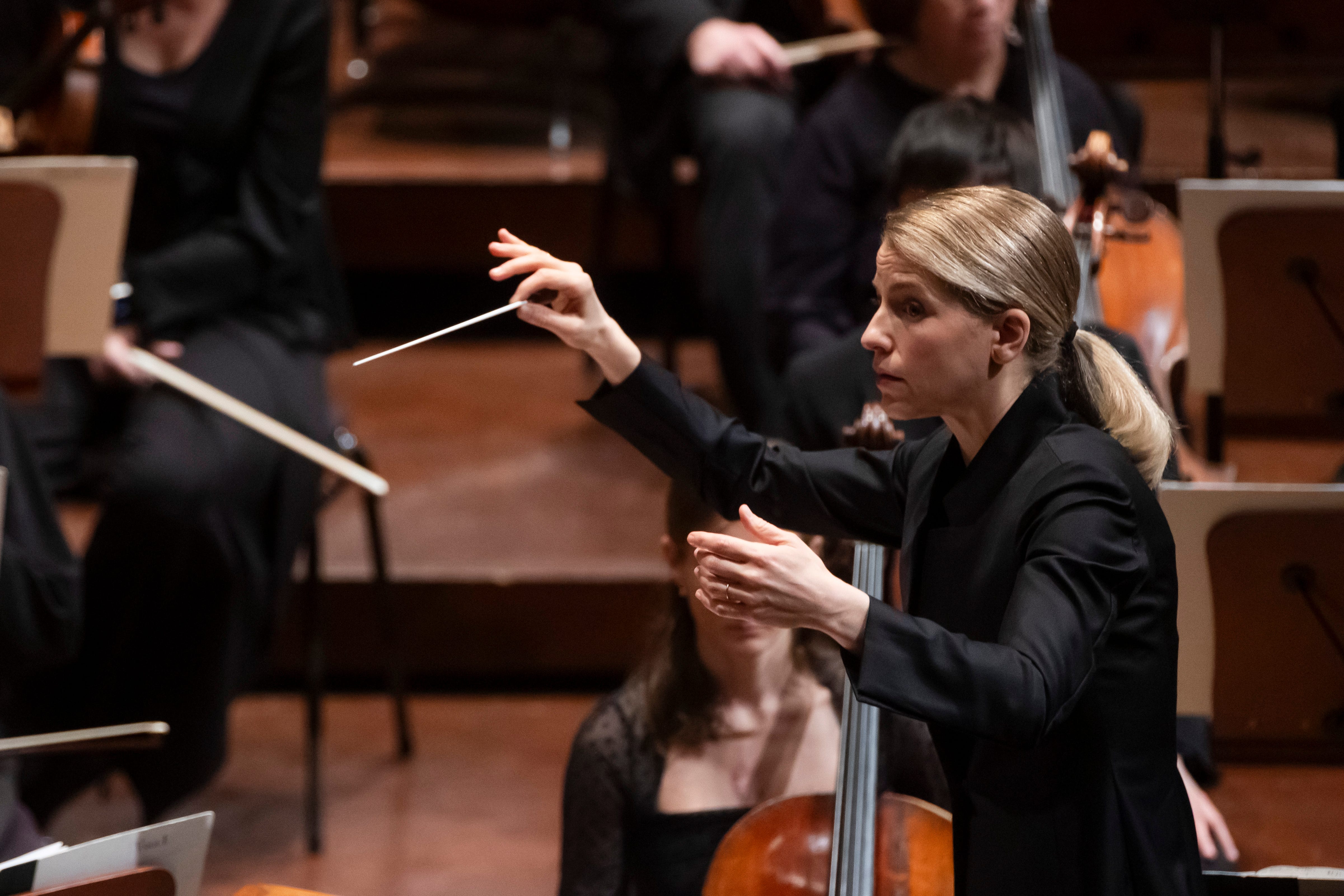
Unfortunately, whatever brilliance Kantorow had displayed in recital was largely lacking on Saturday night — or at least, was overrun by Canellakis’s long-demonstrated propensity for massive blocks of orchestral sound and loud-louder-loudest dynamics. I’m not entirely certain what Kantorow brought to the performance in the way of textural clarity or interpretive insight, because everything he did had to muscle its way past Canellakis’s Phil Spector-ish Wall of Sound.
He contributed plenty of bravado to the energetic finale, but who cares? The point of this concerto, as far as I’m concerned, lies elsewhere — in the purring, insinuating machinery of the first movement and the expressivity and understated wit of the central theme and variations. If Kantorow was interested in any of those qualities, he kept the fact well concealed.
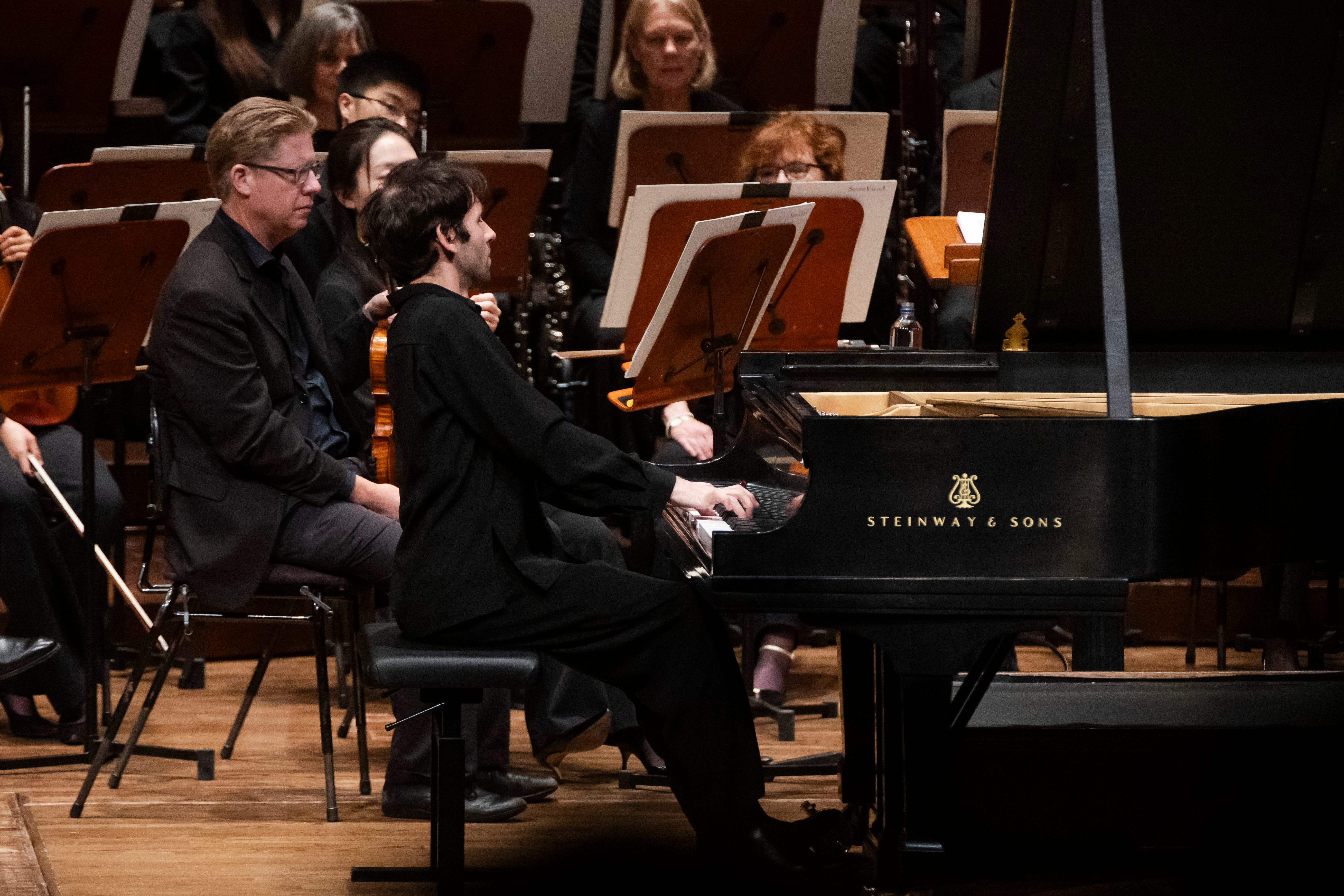
The evening’s one high point was his encore, a shimmery and superbly paced transcription by Guido Agosti of the final scene from Stravinsky’s Firebird. Otherwise, there was the second Symphony performance of Dvorák’s workmanlike Scherzo capriccioso, and an unmodulated account of Sibelius’s Four Legends from the Kalevala, graced as expected by English hornist Russ de Luna’s exquisitely shapely portrait of the title character in “The Swan of Tuonela.” Next time I may have to pay more heed to those premonitory doubts.
Elsewhere:
Rebecca Wishnia, San Francisco Chronicle/SFCV: “Sibelius uses the full orchestra sound sparingly — often, a motif will take minutes to spread over the stage — and this performance was perfectly paced. The simmering tremolo in ‘Lemminkäinen in Tuonela,’ when it finally boiled up in roaring brass chords, was frankly terrifying. The high strings’ icy lullaby was hypnotic.”
Fab four
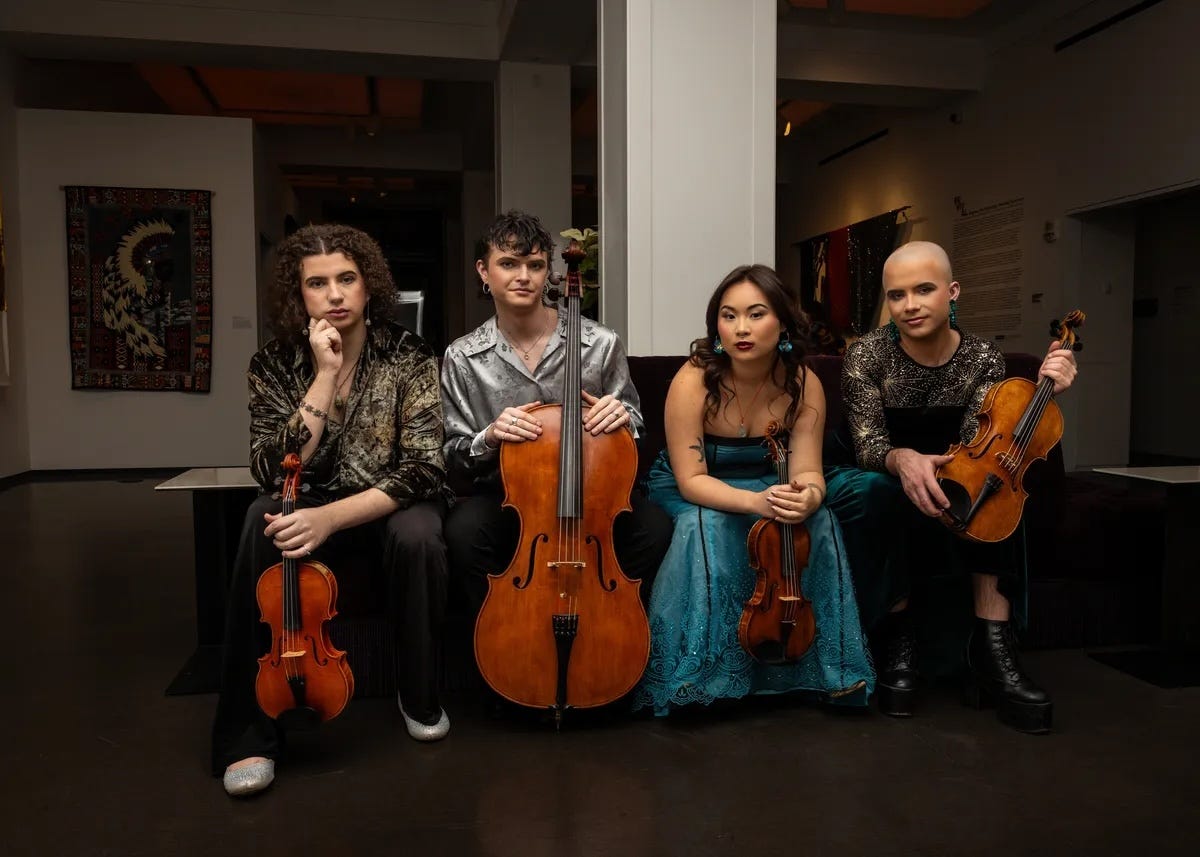
On the other hand, sometimes the advance buzz is everything you want it to be. A couple of months ago, critic Lisa Hirsch tipped me to an upcoming visit by the Poiesis Quartet, a young ensemble out of Cincinnati that had just taken top prize in the Banff International String Quartet Competition. Shortly thereafter, critic Rebecca Wishnia published a long and persuasive report about both the competition and the Poiesis’s victory.
I understand when the universe is giving me marching orders, so on Sunday afternoon I made my way to Noe Valley Ministry to hear the group for myself. It was entirely as advertised — a program full of wit, commitment, communicative ardor, and technical prowess, made all the more enticing by the inviting and acoustically wonderful performance space.
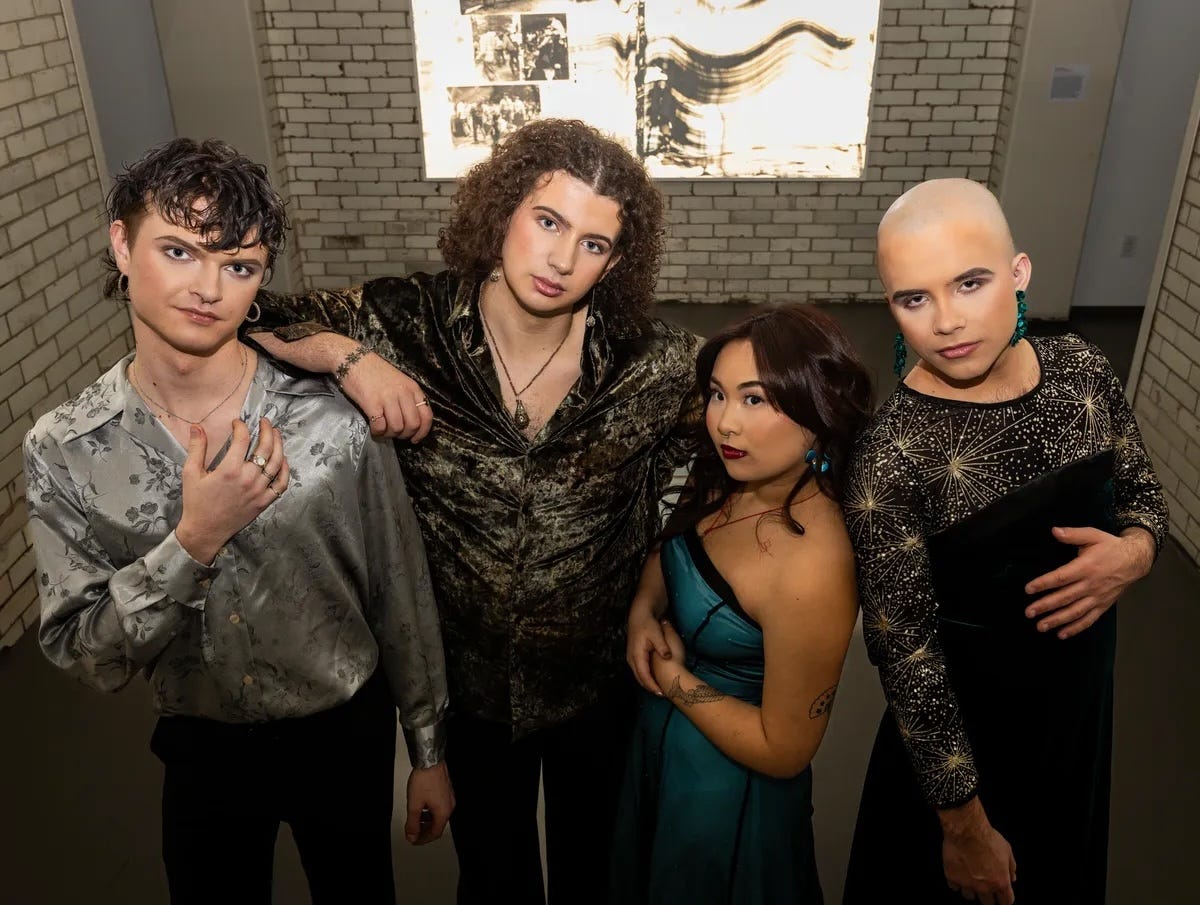
One of the many things to appreciate about the Poiesis (violinists Sarah Ying Ma and Max Ball, violist Jasper de Boor, and cellist Drew Dansby) is the way their commitment to new music entails not just advocacy but discovery. The composers on this program were almost all new names to me (Jerod Impichchaachaaha' Tate and Sergei Prokofiev were the outliers), and in each case I got both a stellar performance of a particular piece and an assignment for further research.
I was particularly moved by the String Quartet No. 7, commissioned by the group from the Chinese Canadian composer Kevin Lau. The piece, subtitled “Surfacing,” depicts the turmoil and eventual resolution of a family health crisis. Over the course of a single 15-minute span, Lau frantically casts his attention on a range of stylistic and thematic worlds, as if searching for some kind of consolation or relief. The sections are demarcated by a dark, chuggy semitone motif that combines the formal strategy of Tchaikovsky’s Fourth Symphony with the musical material from John Williams’ Jaws soundtrack.
Other delights on the program were Sky Macklay’s hilarious and conceptually slippery Many, Many Cadences, a 10-minute quartet comprising exactly what it says on the tin, and Brian Raphael Nabors’ String Quartet, a kind of cosmological soap opera in music. I feel grateful to now have all these composers, and the splendid quartet that made the introduction, on my radar.
Coming up (special abundance edition)
Each week I conclude the column with tips on future events that might be of interest to readers, and under normal circumstances I stop at two or three. But the coming weekend isn’t remotely normal.
It brings a musical traffic pileup of the kind that happens maybe once in ten years, if that. There are so many events converging on the same few days that some of us were already looking at the calendar last spring, trying to figure what we could cram into our schedules and what we would have to regretfully skip.
In the end, my weekend plans include four concerts over three days: the world premiere of The Monkey King at San Francisco Opera, Ars Minerva’s production of Antonia Bemba’s 1707 opera Ercole Amante (Hercules in Love), and back-to-back Sunday concerts by the San Francisco Contemporary Music Players and cellist Gautier Capuçon. Even with that schedule, these are some of the events I’ll have to miss.
• Modigliani Quartet: The enterprising young French ensemble returns to San Francisco with a program that includes music of the 99-year-old Hungarian master György Kurtág, along with Haydn and Beethoven. Nov. 14, Herbst Theatre. www.sfperformances.org.
• Jeremy Denk: The ever-insightful American pianist devotes a Berkeley recital to Bach’s Six Partitas. Nov. 14, Zellerbach Hall, UC Berkeley. www.calperformances.org.
• Oakland Symphony: The orchestra and music director Kedrick Armstrong continue their season with the Verdi Requiem, along with a commissioned world premiere by Bay Area composer Cava Menzies. Nov. 14, Paramount Theatre, Oakland. www.oaklandsymphony.org.
• Tanya Gabrielian: The Bay Area pianist offers a solo recital featuring music by San Francisco composer Sahba Aminikia alongside Schumann’s Kinderszenen and Alfred Cortot’s solo piano arrangement of the Franck Violin Sonata. Nov. 14, Old First Church. www.oldfirstconcerts.org.
• Berkeley Symphony: Bay Area conducting luminary Ming Luke is the latest music director candidate to lead the orchestra, with a program featuring soprano Laquita Mitchell in Strauss’s Four Last Songs along with music by Juan Pablo Contreras, Missy Mazzoli, and Dmitri Shostakovich. Nov. 15, First Congregational Church of Berkeley. www.berkeleysymphony.org.
• Miró and Isidore String Quartets: Mendelssohn’s Octet for Strings, written when the composer was 16, gets my vote for the most astonishing piece by a teenager. Two estimable string quartets, the Miró and the Isidore, join forces to play this masterpiece as well as music by Haydn and Caroline Shaw. Nov. 15, Weill Hall, Green Music Center, Sonoma State University. gmc.sonoma.edu.
• San Francisco Choral Society: Under the leadership of artistic director Robert Geary, this nonprofessional choir covers a wonderful range of repertoire from choral classics to contemporary work. The weekend’s program features Vaughan Williams’ beloved Dona nobis pacem and music by the Norwegian composer Ola Gjeilo. Nov. 15-16, Trinity + St. Peter’s Episcopal. www.sfchoral.org.
• California Symphony: Music director Donato Cabrera leads the orchestra in a season-opening program of Mozart, Beethoven, and Jessie Montgomery, with pianist Robert Thies as the featured soloist. Nov. 15-16, Lesher Center for the Arts, Walnut Creek. www.californiasymphony.org.
• Madama Butterfly: Soprano Emily Michiko Jensen takes the title role in Opera San José’s production of the Puccini classic, with mezzo-soprano Kayla Nanto, tenor Christopher Oglesby, and baritone Eugene Brancoveanu completing the quartet of principals. Nov. 16-30, California Theatre, San Jose. www.operasj.org.
• San Francisco Symphony Chamber Series: Concertmaster Alexander Barantschik, cellist Peter Wyrick, and pianist Anton Nel join forces for an all-Beethoven program of piano trios. Nov. 16, Gunn Theater, Legion of Honor. www.sfsymphony.org.
• San Francisco Civic Music Association: This orchestra, populated by amateur musicians and offering free concerts of a wide range of repertoire, is one of the Bay Area’s understated musical assets. To begin the season, music director John Kendall Bailey leads the orchestra and Chora Nova in music by Mozart, Beethoven, and Anton Reicha. Nov. 16, Herbst Theatre. www.sfcivicmusic.org.
• Nebula Consort: A new addition to the Bay Area’s musical landscape, this young choral ensemble launches its first season with a program featuring Bach’s motet Der Geist hilft unser Schwachheit auf and a variety of Psalm settings from a 400-year period. Nov. 16, Mission Dolores. www.nebulaconsort.org.
• Trio Bohémo: The Czech ensemble makes its first appearance on the Music at Kohl Mansion series with piano trios by Bohuslav Martinů, Jan Vičar, Bedřich Smetana and a non-Czech ringer, Franz Joseph Haydn. Nov. 16, Kohl Mansion, Burlingame. www.musicatkohl.org.
Cryptic clue of the week
From Out of Left Field #293 by Henri Picciotto and me, sent to subscribers last Thursday:
Reflect on endless honesty: it’s impossible (2,3,2)
Last week’s clue:
Aspire to convert ancient empire (6)
Solution: PERSIA
Aspire: anagram fodder
to convert: anagram indicator
ancient empire: definition
Small correction: Friday's concert is not the Oakland Symphony's season opener. They opened on October 17, with Adolphus Hailstork in the audience as well as on the program.
I feel fortunate to know little and be a nobody, as it allows me to forego the world premier and see The Monkey King Tuesday night. Many fewer competing programs!