
Language games
Pocket Opera’s new production turned a translated libretto into a dramatic resource

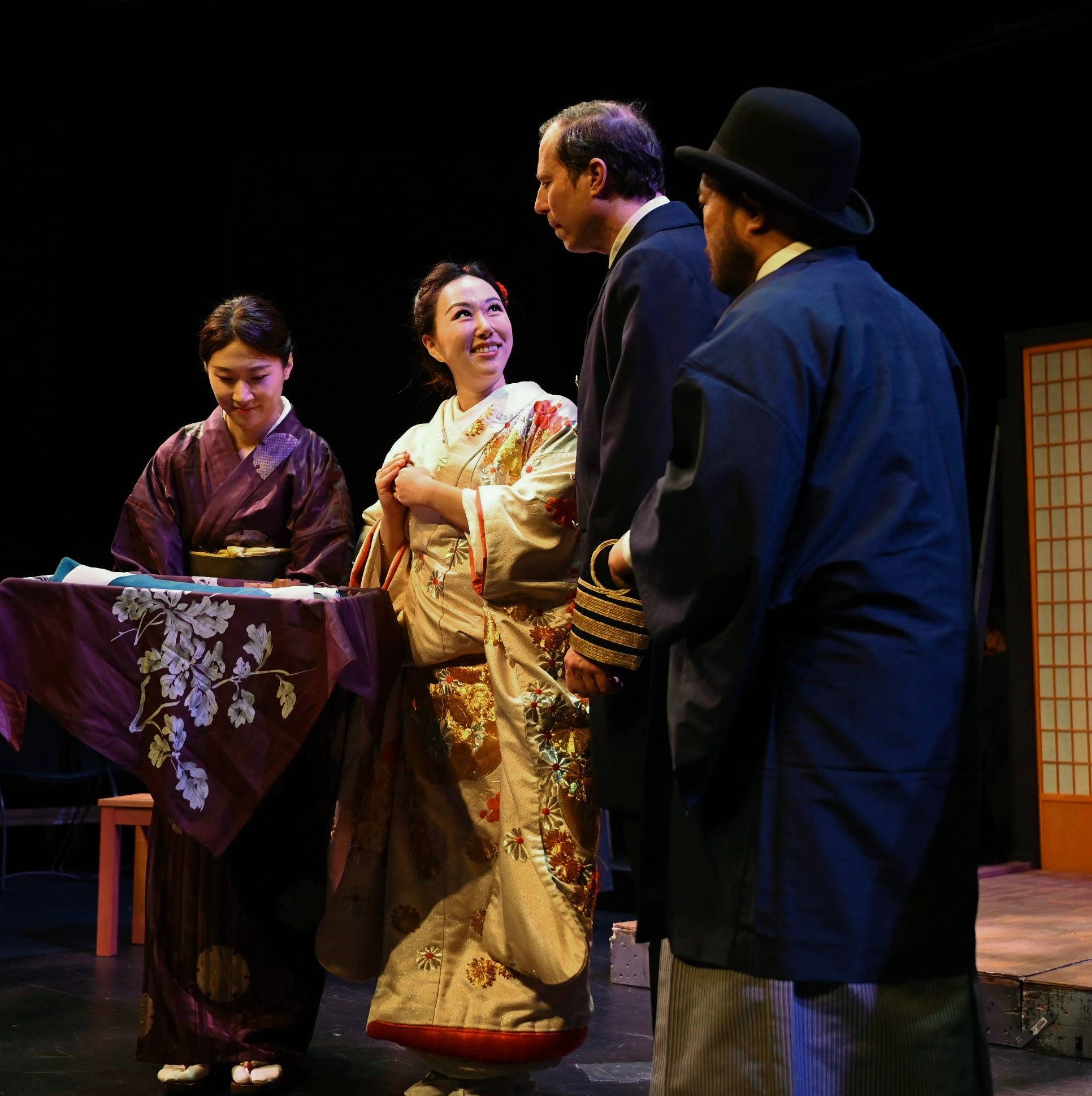
One of the minor oddities of Puccini’s Madama Butterfly is the fact that Cio-Cio-San and Lt. Pinkerton manage to communicate perfectly well despite knowing nothing of one another’s worlds. It’s as though operatic Italian were a lingua franca familiar to everyone, from the teenage geisha to the vagabond Yankee sailor who prowls the seas.
On its own, this isn’t an earth-shaking observation; after all, “everyone here speaks the same language” is a time-honored dramatic convention, from Spanish barbers warbling in Italian to English-speaking movie Nazis. But Butterfly is an opera whose primary theme is the perils of missed cultural connection. The fact that neither of the lead characters has a clue what’s going on in the other’s head is what the piece is about. Once you think about it from that perspective, the standard linguistic practices of Italian opera start to feel a little strained.
The deft production by Pocket Opera that opened Friday night at the Mountain View Center for the Performing Arts addresses that tension directly, and the results are striking. The production, skillfully directed by Melody Tachibana King from a version first created by Los Angeles’ Pacific Opera Project, uses a bilingual translation of the libretto. The Americans sing in English, the Japanese sing in Japanese, but crucially, two of the characters are bilingual and can act as interpreters. Sharpless, the American consul, has been living in Japan for a long time, and can of course speak the language (he’s also, as in the original libretto, Pinkerton’s guide to local mores). And the marriage broker Goro presumably has frequent dealings with international clients whom he can’t address in Japanese.
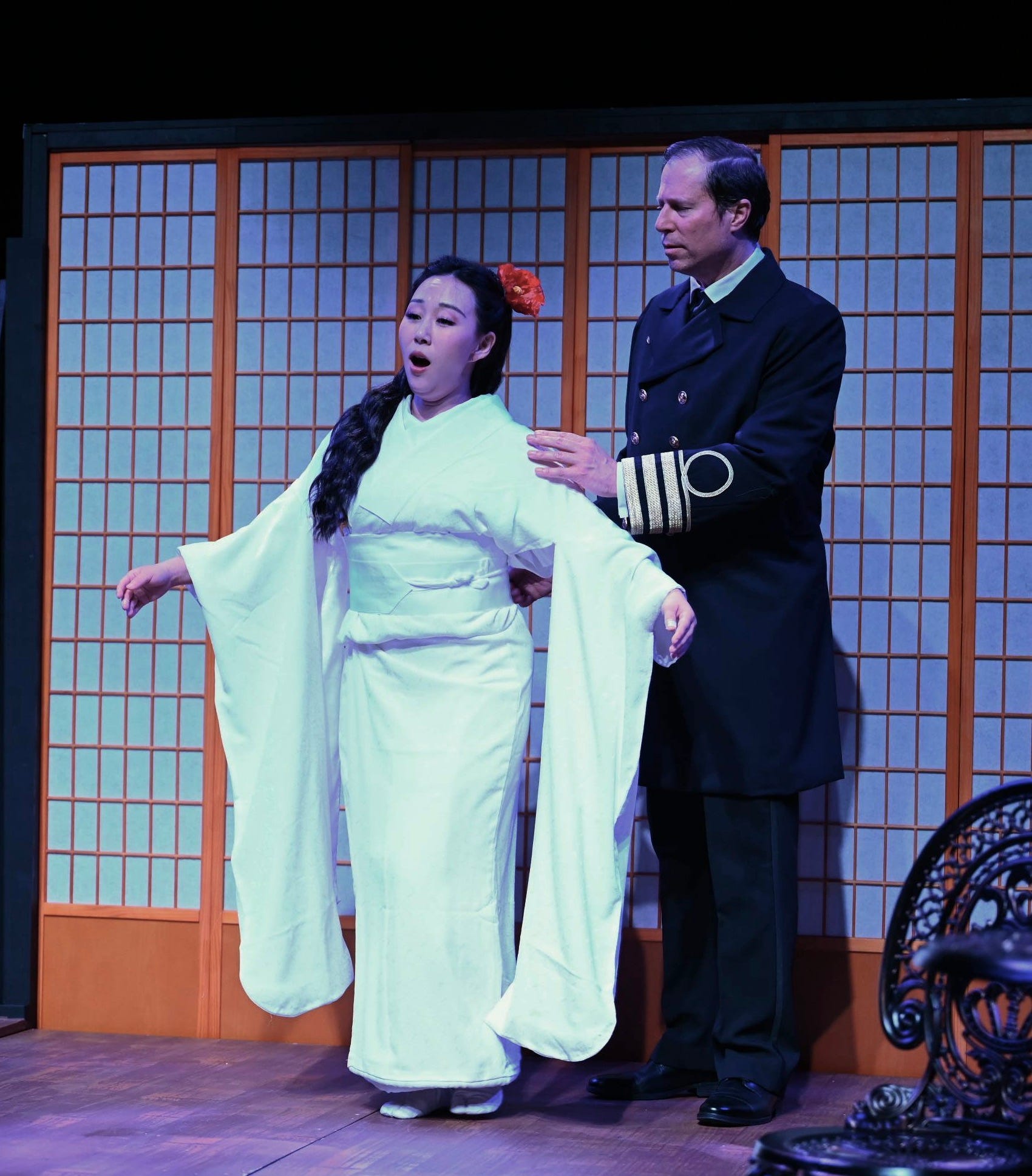
So in this production, any group of compatriots (Pinkerton and Sharpless during the jingoistic “Dovunque al mondo” in Act 1, the Japanese characters and the Japanese-speaking Sharpless through the entirety of Act 2) converse freely. At other junctures, the two translators hover behind the interlocutors, discreetly whispering into their ears. It’s a brilliantly effective device that breaks down only once, during the sumptuous love duet that concludes Act 1 — the only point in the opera at which Cio-Cio-San and Pinkerton are alone together.
Performing the standard repertoire in English is central to the DNA of Pocket Opera, going back to the company’s founder and longtime artistic director Donald Pippin. But as with any opera in translation, the philosophical motivation has always been accessibility: letting the audience understand what’s happening on stage. This may be the first time I can recall in which the choice(s) of a production’s language had a direct impact on the drama.
And what an impact! Again and again, the linguistic divide deepens or reshapes our understanding of familiar scenes. The negotiations and paperwork surrounding the Act 1 marriage ceremony now convey a detailed sense of how clumsy the whole affair is, with each line having to be translated for the benefit of whichever character is being addressed. In the comfortable mutual embrace of Cio-Cio-San, Suzuki, and Trouble during the last half of Act 2, we feel more deeply than ever this is the opera’s true family, the ones who belong together.
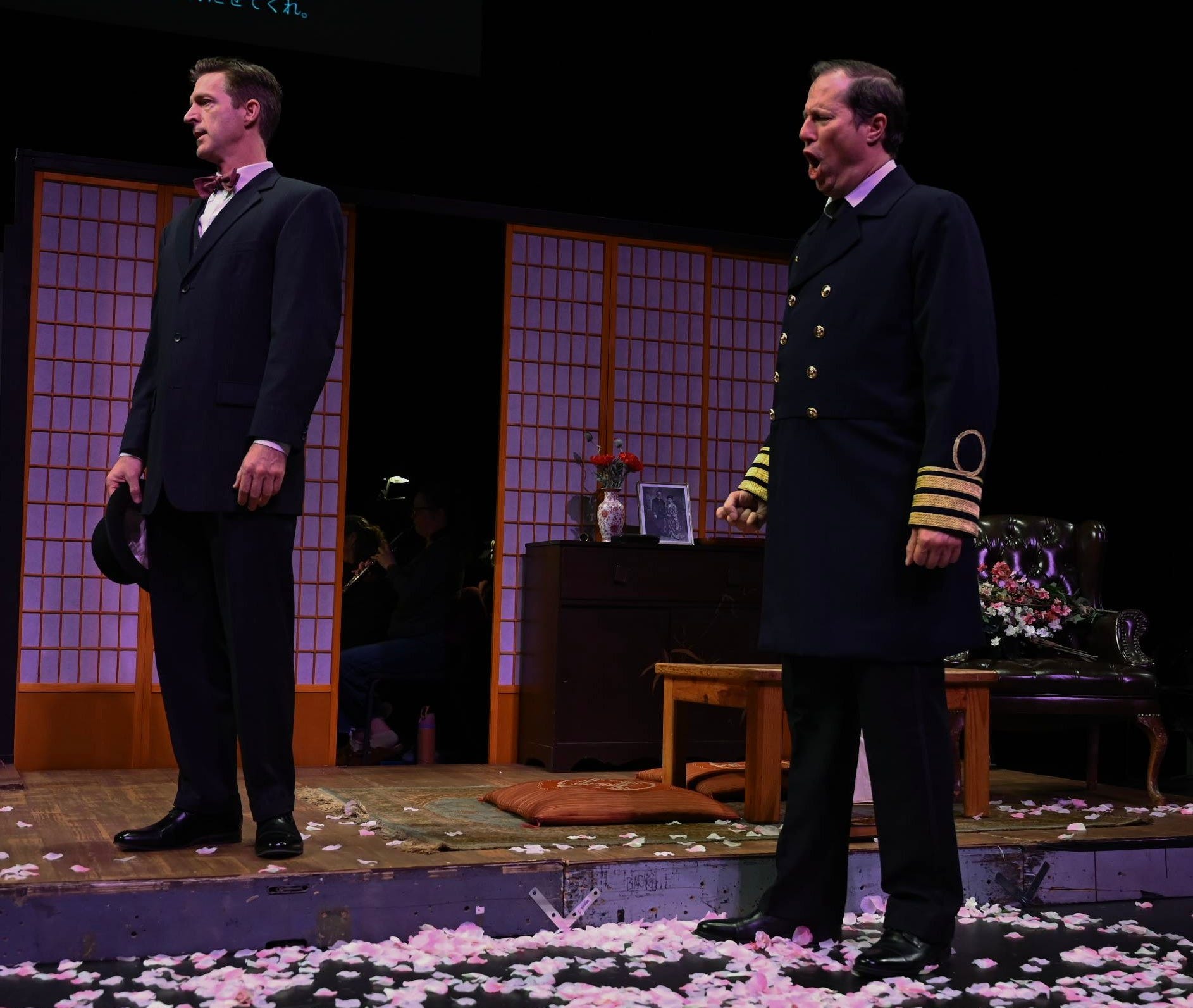
Most stirring of all is Pinkerton’s return in Act 3. The minute he steps onstage, of course, the audience thinks what it always thinks: Fuck you, we all hate you, look what you’ve done, go away. But our contempt for the man becomes more profound as we watch him blundering about in his stupid Navy uniform and think, He can’t even speak the language! It’s one thing to know that Pinkerton has heedlessly destroyed the one person, the one love that is beautiful and true in this opera; it’s another to understand, this late in the proceedings, that he’s never had a clue about anything since the curtain first went up.
Musically, this Butterfly was enlivened by the luminous, impeccable Cio-Cio-San of soprano Hannah Cho, in a performance of tender, steely grace and radiant melody. Tenor Chester Pidduck didn’t have the high notes for Pinkerton, but Anders Fröhlich (Sharpless), HaYoung Jung (Suzuki), and Joachim Luis (Goro) sang with nimble authority throughout.
Madama Butterfly: Pocket Opera. March 1, Hillside Club, Berkeley. www.pocketopera.org.
Elsewhere:
Lily Janiak, San Francisco Chronicle: “As [Hannah] Cho’s Butterfly makes some notes gossamer, others cannon blasts, others still like textured, woodsy strokes of a violin’s bow, we’re not just responding to satisfying melodies sumptuously rendered.”
Dutch treat
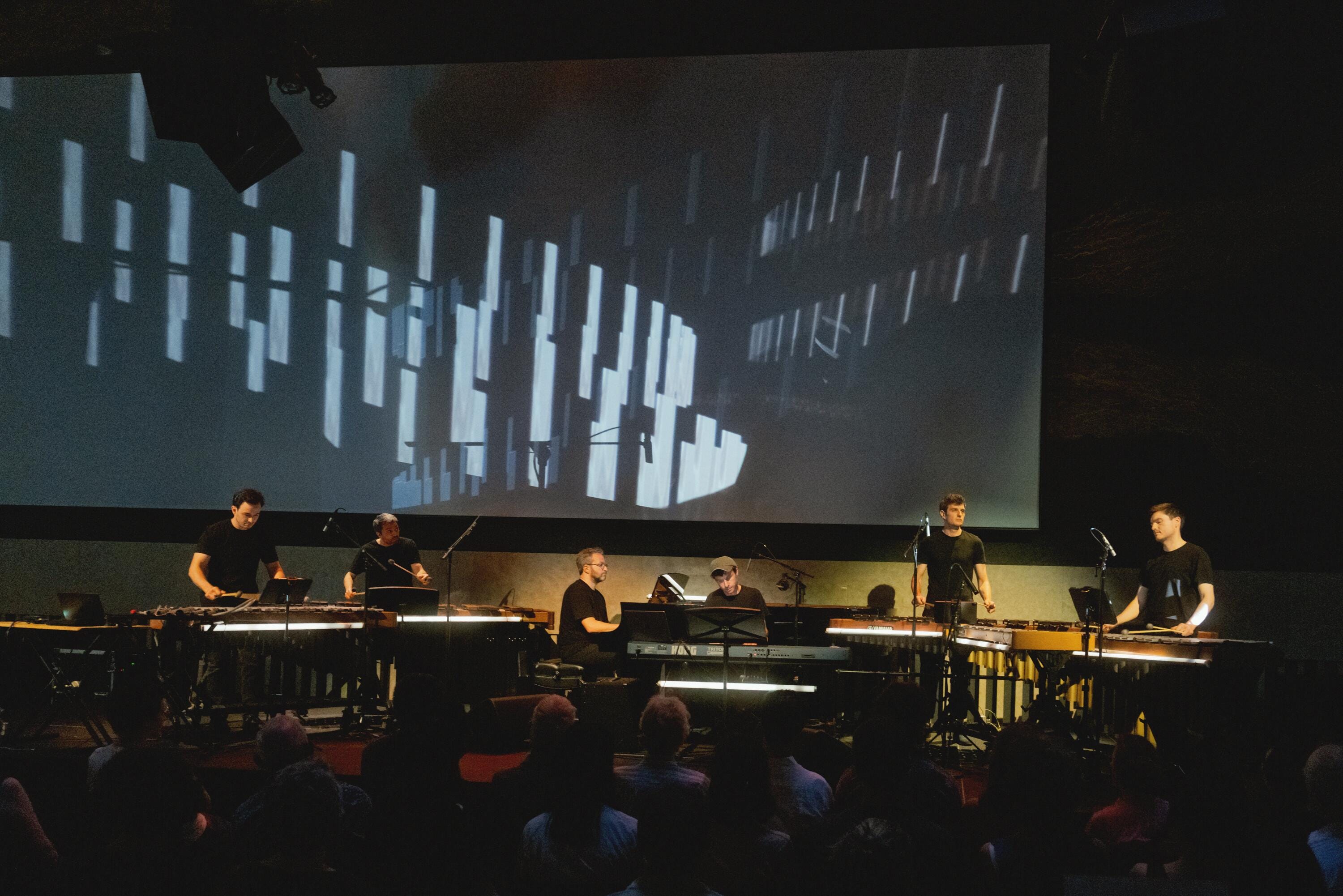
Candor compels me to admit that before Sunday afternoon’s ravishing performance of Canto Ostinato at Berkeley’s Zellerbach Playhouse, I was familiar with neither the Dutch composer Simeon ten Holt nor his magnum opus, a 1976 exercise in early minimalism. (I console myself with the knowledge that ten Holt is also unknown in the pages of the New Grove Dictionary of Music and Musicians, at least as of the physical publication of the 2nd Edition in 2001.)
But that only meant that the richness and beauty of the event, presented by Cal Performances, struck me with the force of a benign but awe-inspiring thunderbolt. This was music whose premises and textures were familiar up to a point — the piece bears some obvious resemblances to Steve Reich’s Music for 18 Musicians, its exact contemporary — but its emotional profile felt more generous, more sweetly shambling, than Reich’s crystalline brilliance. Minimalism in those days was evidently practiced differently on the two sides of the Atlantic.
The instrumentation for Canto is deliberately left open; the score says merely, “for keyboard instruments.” On this occasion, the members of the quartet Sandbox Percussion, playing two marimbas and two vibraphones, were joined by (from the American Modern Opera Company) pianist Conor Hanick and Matthew Aucoin on synthesizer. The length of a performance is also variable, because the piece consists of 106 small fragments of a few measures, each of which can be repeated as many times as the performers wish. Sunday’s performance clocked in at about 75 minutes; others can reportedly run several hours.
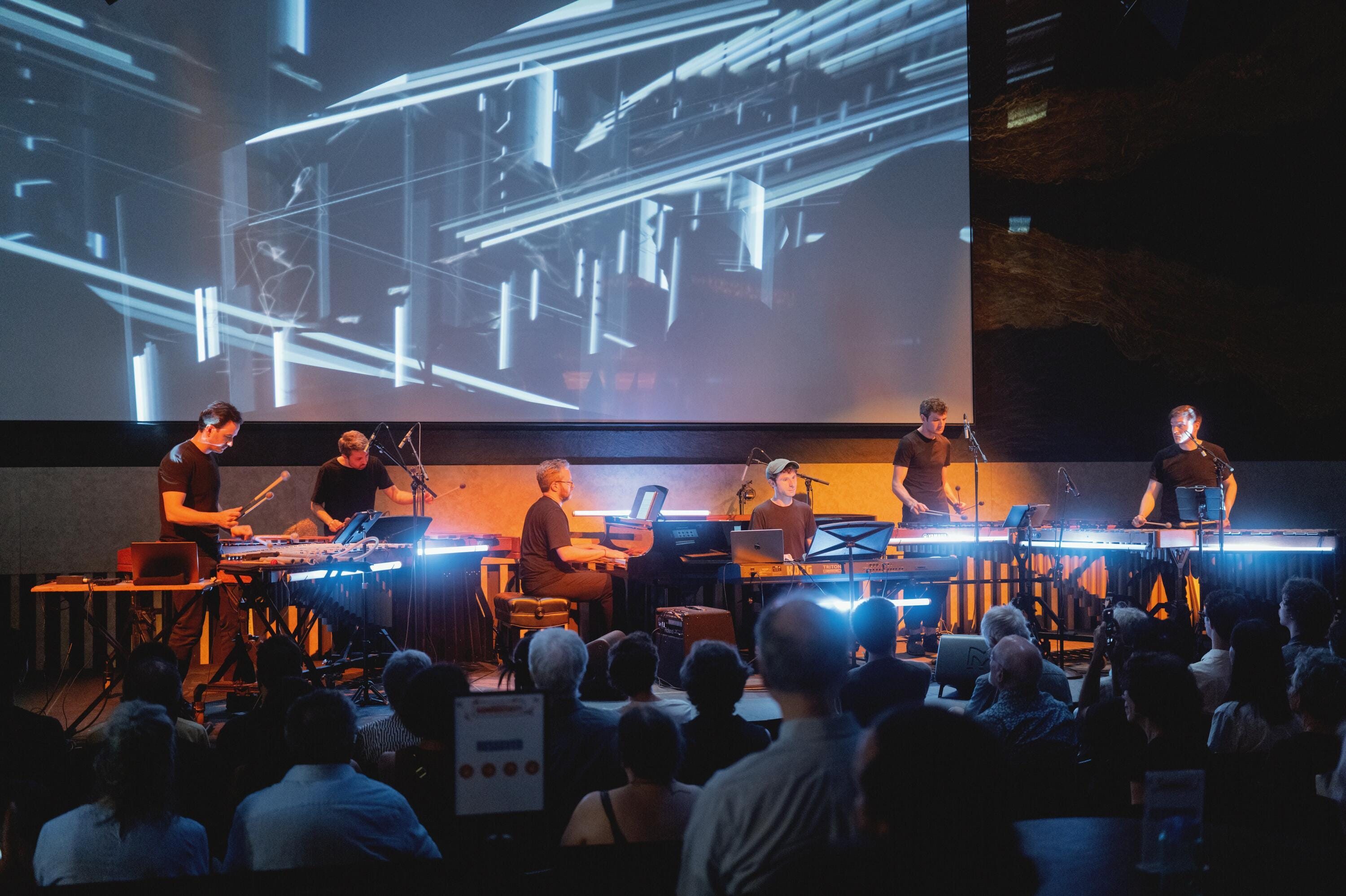
Within those indeterminate boundaries, though, the music has a very specific physiognomy. There’s a five-beat pulse running through nearly the entire piece, which is so gentle that its asymmetries often barely register; at times it just feels like a balmy tropical dance for people with two and a half feet each. For a long time, the rhythms underpin a series of simple modal harmonies, alternating and giving way to one other as if in no hurry to get anywhere. The dynamic level, permanently set on low-to-medium, encourages a Lethean haze.
Then, shortly before the halfway point, something new appears on the landscape: a chromatic note, followed by more. They’re unobtrusive at first, nothing more than ornaments. But soon they rewrite the harmonic logic of this musical world. If there are chromatic notes, that means we can have dominant sevenths; we can also have a new and sinuous brand of counterpoint. Before long, ten Holt assembles and recombines these elements into an elegant slow tango in many voices. In a landscape that had previously been largely featureless, the new strains arrive like an evolutionary breakthrough, at once unheralded and entirely logical. That development, like the entire work, is gorgeous and utterly mesmerizing.
Elsewhere:
Lisa Hirsch, San Francisco Chronicle/SFCV: “It was a sonically magical combination. Percussion instruments they may be, but together they created a wash of sound that was, paradoxically, both exciting and soothing. The music demanded attention, even as it verged on the hypnotic.”
Cryptic clue of the week
From Out of Left Field #308 by Henri Picciotto and me, sent to subscribers last Thursday:
Out of control, Faye changes party affiliation (7)
Last week’s clue:
Composer’s ego interfering with stuff (5)
Solution: SATIE
Composer: definition
ego: I
interfering with: container indicator
stuff: SATE
Coming up
• Snapshot: Over the years, West Edge Opera’s periodic showcase of new works in progress has been a surefire revelation. Naturally, some of the pieces on display aren’t ready for prime time yet, but there’s always something to listen to with delight and anticipation. This year’s batch includes operas about Iran, broadcast news, wolves, and golems. Feb. 28, First Congregational Church, Berkeley. March 1, Taube Atrium Theater. www.westedgeopera.org.
• Così Fan Tutte: The Livermore Valley Opera has a knack for staging works of the standard operatic repertoire with such flair and vitality that they feel new again. The current production features the last of Mozart’s three collaborations with librettist Lorenza da Ponte, a mordant comedy about fidelity in love affairs. Among the six-member ensemble cast are soprano Meryl Dominguez (who shone in the company’s Don Giovanni last year), former Adler Fellow Samuel Kidd and Bay Area stalwart Eugene Brancoveanu. Feb. 28-March 8, Bankhead Theater, Livermore. www.livermorevalleyopera.com.
I have a subscription to Grove online and supposedly there is a ten Holt article, but either it's theoretical or it wouldn't load for me.
I'll be at LVO on Saturday and Snapshot on Sunday.