
Our man in Berlin
I went to Europe to hear Donald Runnicles conduct the Ring Cycle yet again

In the summer of 1990, when I was the second-string music critic for the Chronicle (when the Chronicle had different strings in its arts coverage!), the San Francisco Opera presented four complete cycles of Wagner’s Ring within less than a month. The Austrian conductor Peter Schneider, a relatively senior figure, conducted the first two, while the latter cycles were entrusted to an unknown young Scotsman, the 36-year-old Donald Runnicles, who was making his U.S. debut.
As the low man on the totem pole (again — there was a totem pole!) it fell to me to write about the undercard, and few assignments have ever brought me such a sense of serendipitous joy. I remember as though it were yesterday hearing the opening orchestral strains of Das Rheingold fill the War Memorial Opera House — growing from inaudibility to surging power through a series of roiling, rippling arpeggios — and thinking, Man, this guy’s got it. I’m no longer even sure what it was, precisely, that made me think so. But the remainder of that cycle, and Runnicles’ glorious 17-year tenure as the company’s music director, only confirmed that judgment.
I’ve come to Berlin to hear Runnicles conclude another 17-year directorship, with the Deutsche Oper, in yet another Ring cycle. Last night’s opening Rheingold found him in top form, his artistry as vibrant as ever but infused even more with the kind of rich understanding that comes with age —sorry, long experience. To hear him conduct Wagner is like watching two old lovers dance. He knows where the danger spots are, and how to coax and cajole the orchestra into doing its best work. He allows the score to breathe when it needs to, but takes firm command before any hint of laxity creeps in. Balances were largely immaculate (although there was some acoustical weirdness during Rheingold about which I want to reserve judgment until the cycle is complete). Runnicles’ give-and-take with singers has never been short of miraculous, and remains so to this day. And there’s an underlying propulsiveness throughout everything he conducts that keeps you listening in eager anticipation.
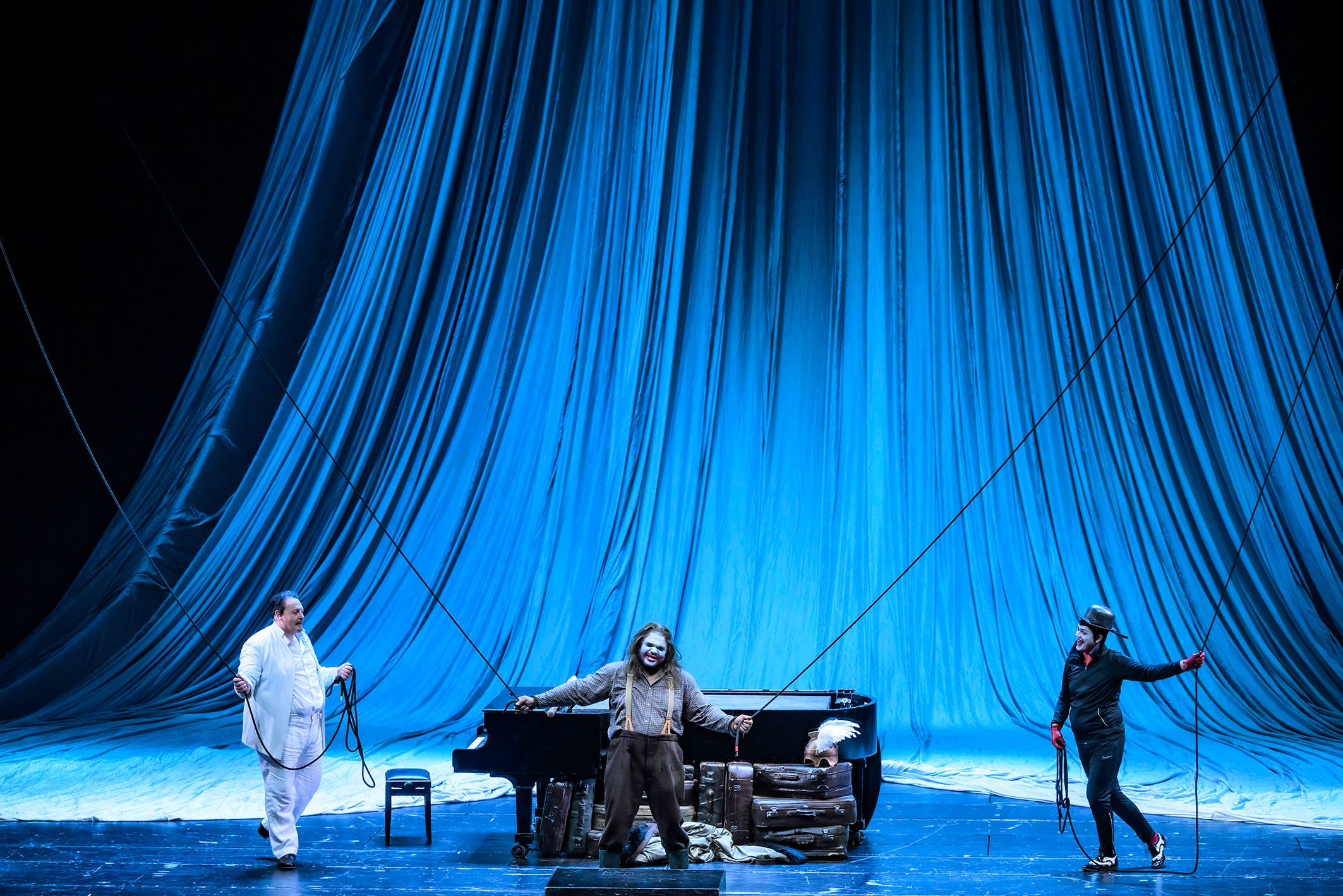
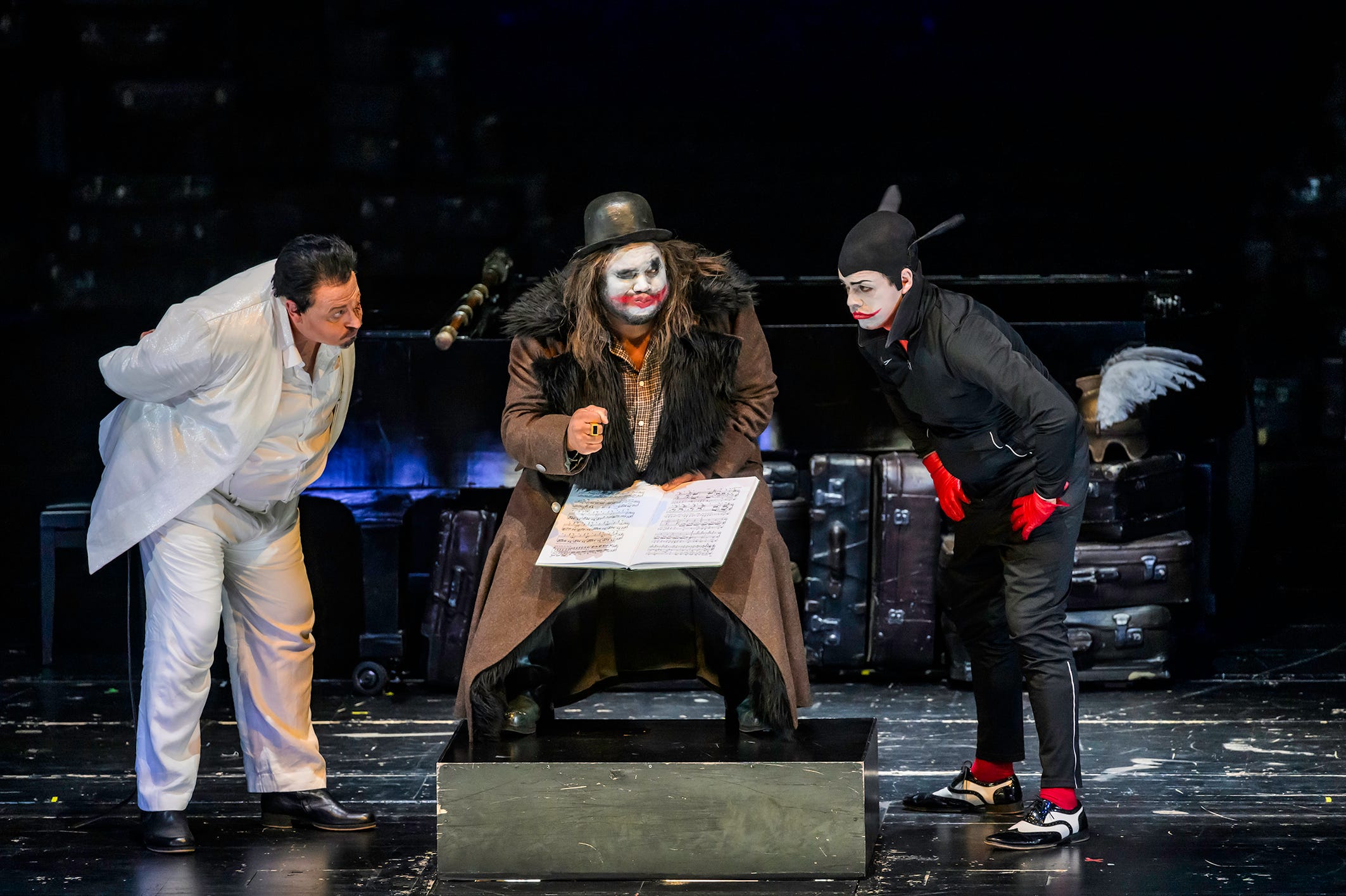
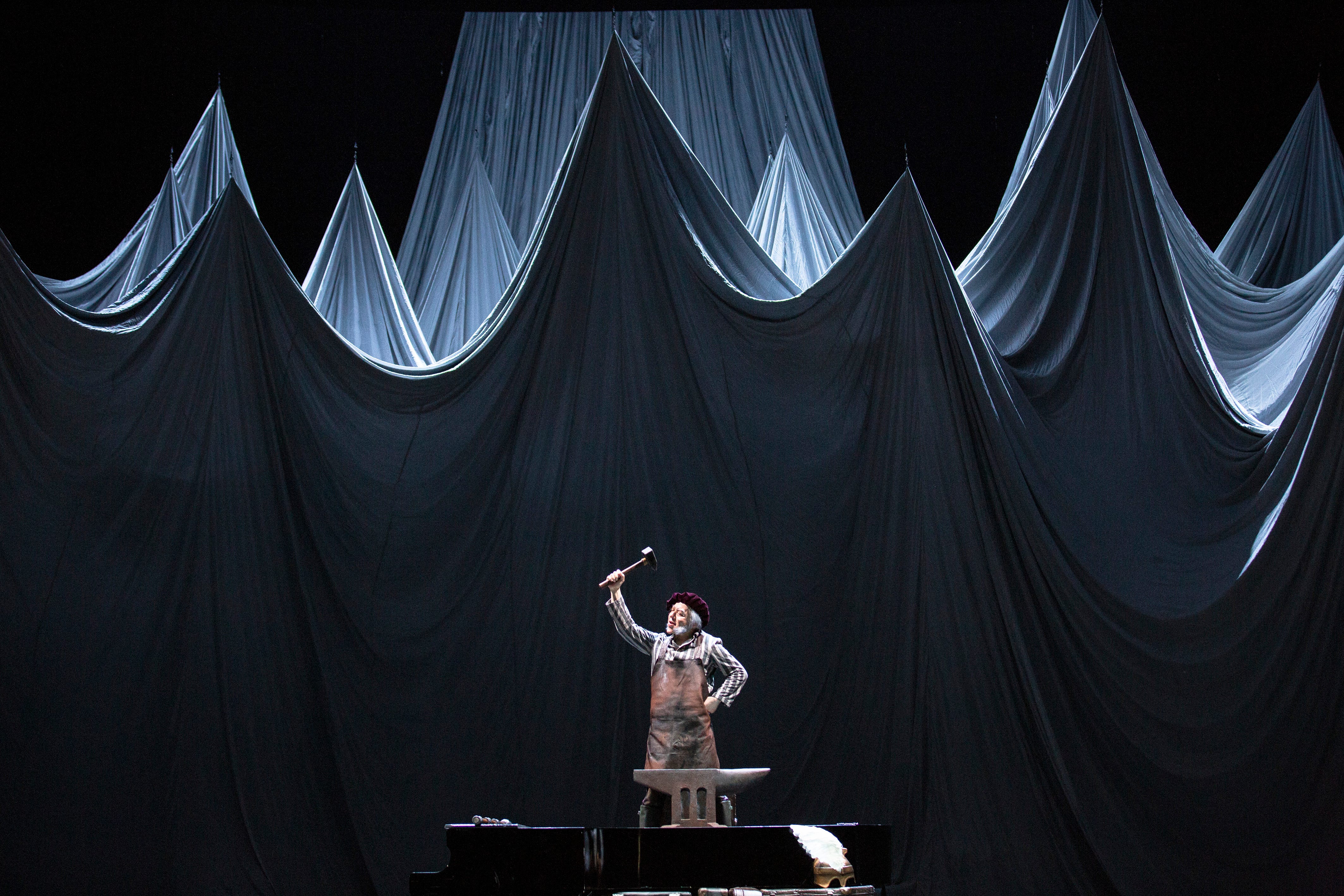
Uncertainty is the lodestar of director Stefan Herheim’s oddball production, which I’m still in the process of trying to figure out. One predominant theme seems to be Herheim’s determination to externalize and physically embody the proposition that the entire drama emerges from Wagner’s score. A large grand piano lives at center stage throughout the opera, with people and objects passing in and out of its open frame, and when a character wants to start some piece of action they sit at the keyboard and play. A hardback copy of the score appears now and again, held aloft like a talisman to enforce the composer’s creative will. In one of the director’s most dazzling inventions, Wotan’s last-minute stroke of inspiration — in which he conceives the scheme of the sword that is supposed to free him from his moral failings — conjures up a literal sword bursting, Alien style, out of the pages of the score.
Other decisions are less fortuitous, in particular the twin clichés of what if the chorus stripped down to their underwear? and wait, doesn’t this kind of remind you of the Third Reich? But Herheim has enough going on to redeem these missteps, including a profusion of bedsheets to convey everything from the waters of the Rhine to the heights of Valhalla, and especially the heart-stopping final projected image of Siegmund and Sieglinde in utero.
The stars of the Rheingold cast were American baritone Michael Sumuel as Alberich, whom we’ll see again, and the brilliant Belgian tenor Thomas Blondelle as Loge, whom alas we will not. (This is always the heartbreak of a first-rate Loge: the knowledge that that’s all you get.) Blondelle’s singing was tart and fearless, ringing out with exquisite clarity as he invested the character with an extra helping of sardonic glee, like some Norse Pee-Wee Herman.
Bass-baritone Iain Paterson fared well enough as Wotan, although he’d begun to fade a bit even by the end of this shortish assignment. But the rest of the cast was uniformly strong, including Ya-Chung Huang as Mime, Annika Schlicht as Fricka, and Albert Pesendorfer and Tobias Kehrer as the giants. Most impressive of all, perhaps, was the Erda of the young American contralto Lauren Decker, a virtuoso display of tonal heft, expressive phrasing, and sheer majestic power; she’s now on my watchlist for any future local appearances.
Next week, a report on the remainder of the cycle, and more.
From the cabinet of curiosities
There are countless works on the operatic repertoire that are never performed, and of course a tiny handful that make up 90 percent of the offerings by the world’s opera companies. Then there are those little-known rarities that lurk on the periphery, whose titles but not their contents are known to opera buffs, and which pop up somewhere every decade or two when some champion or other decides to bring the piece out for a spin.
My Berlin visit happily coincided with an opportunity to make the acquaintance of one such oddity, Richard Strauss’s Die schweigsame Frau. (The title is usually translated as The Silent Woman, but the libretto makes it abundantly clear that The Silent Wife is better.) The 11th of the composer’s 15 operas, it’s an exercise in archaizing comedy, with a libretto by Stefan Zweig based on a 1609 play by Ben Jonson. To say that the piece is never done exaggerates the matter only slightly. Neither the Met nor the San Francisco Opera has ever presented it, and even the Santa Fe Opera, long famed as a champion of all things Straussian, last staged the piece in 1991.
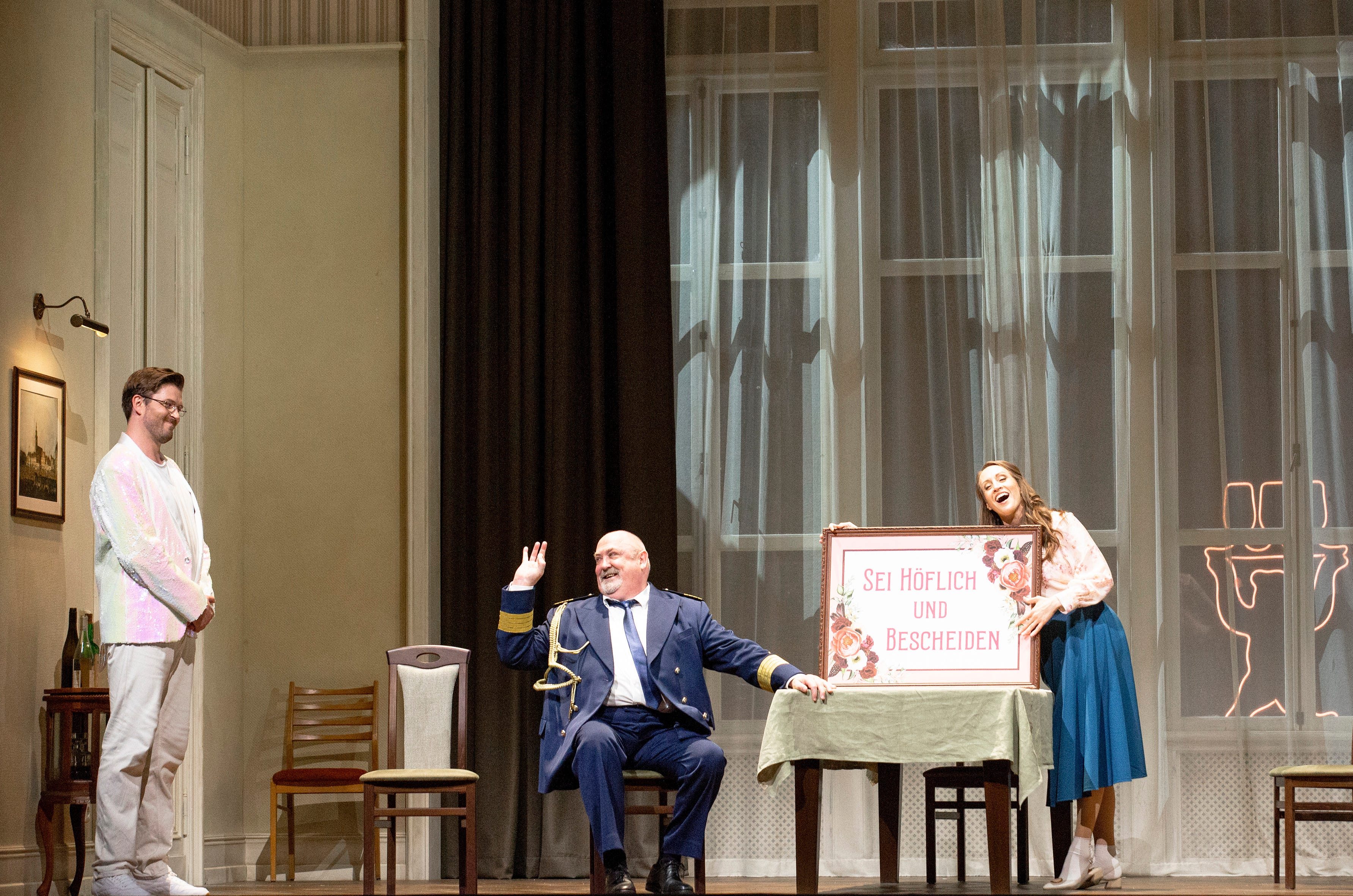
As much as you might try to avoid or at least defer the question, there’s no way around asking yourself, “Is this neglect justified?” And the answer is “Yeah, pretty much.” The score is full of marvels; Strauss never set pen to paper without coming up with something to delight the ear. The story — about a cantankerous old naval captain whose nerves are shredded by noise and who’s ready to remarry if he can find a wife who won’t chatter at him all the time — offers some laughs of an antiquarian variety.
But the piece is very much a retread, the work of a composer with a massive compositional technique and nothing of importance that he cares to do with it. There’s not much in Die schweigsame Frau that Strauss hadn’t already done more persuasively in Der Rosenkavalier, when Mozartean comedy was still a fresh challenge for him, or in Ariadne auf Naxos. You can sense how the piece’s three acts serve as a framework whose only purpose is to be filled in, at which point Strauss can sign his name and move on to the next project.
That said, the ideal number of times to experience the piece in a lifetime is probably one — better than never, better than more. And the production that closed Monday night at the Staatsoper Unter den Linden, conducted with steely elegance by Christian Thielemann (the company’s music director) and graced by a terrific cast of singers, served the purpose ideally. In particular, the fluid grace of Strauss’s orchestral style — the way he weaves silvery melodic strands into an increasingly intricate mesh of cross-references and dramatic emphases — emerged in all its glittery, slightly vacuous splendor.
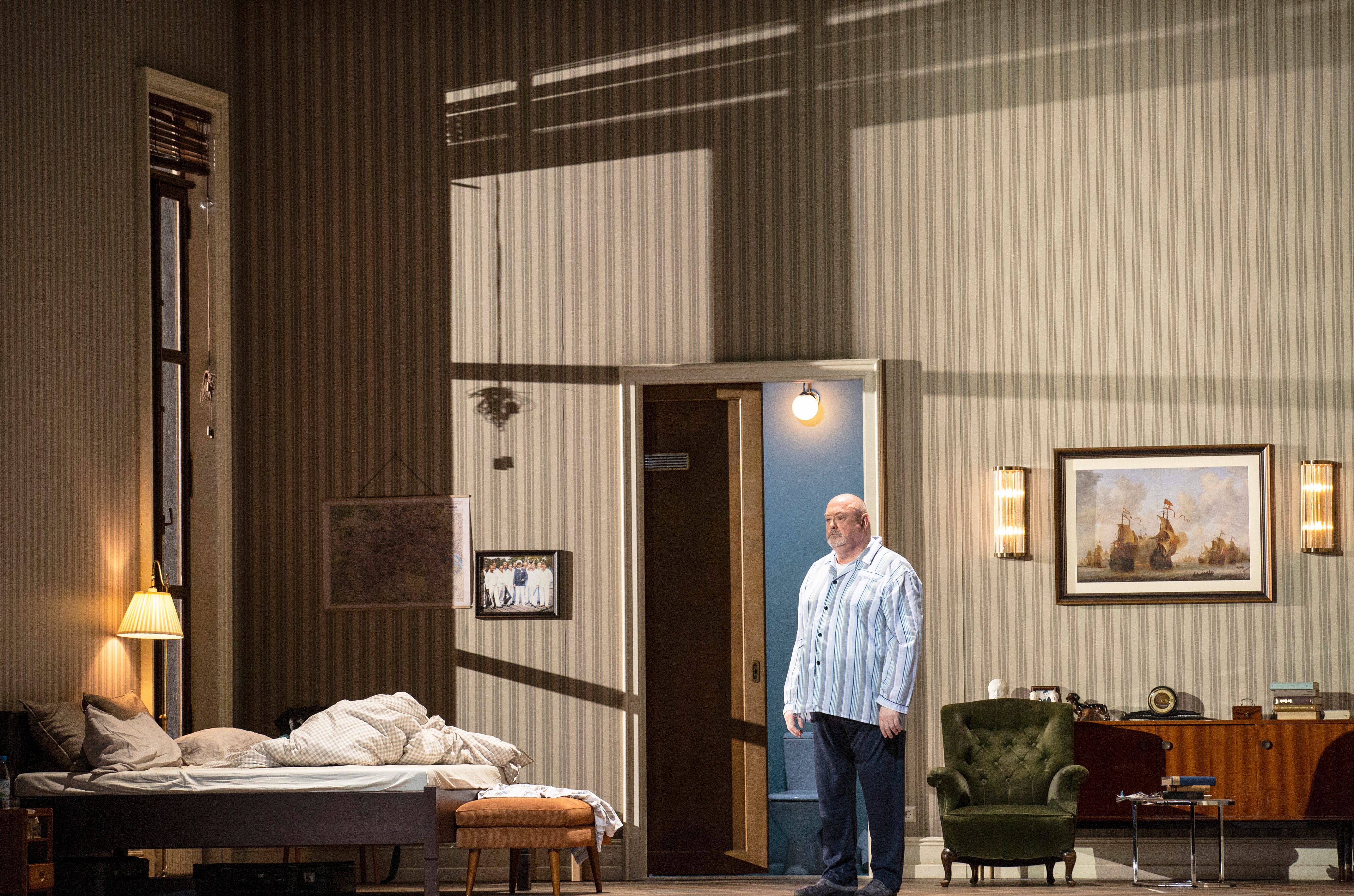
If the success of this opera rises or falls on the strength of the central performance (I read that in the New Grove Dictionary of Opera and by gum, it’s true), then the British baritone Peter Rose deserves much of the credit. In a superb performance as Sir Morosus, he gave the character full dimensions beyond his pasteboard roots, letting the audience feel the vulnerability and pathos beneath the curmudgeonly exterior, and singing with capacious energy throughout a gruelingly long assignment. Baritone Samuel Hasselhorn was a lively, alert presence as Morosus’s conniving barber, and soprano Brenda Rae brought crystalline precision to the role of Aminta (the wife-to-be who’s actually not). For me, the evening’s most thrilling discovery was South African tenor Siyabonga Maqungo, whose turn as Morosus’s beloved nephew Henry was a wonder of tonal freshness and theatrical charm. The score’s high point is the exquisitely erotic duet for Henry and Aminta that concludes Act 2, and Maqungo and Rae made it glisten.
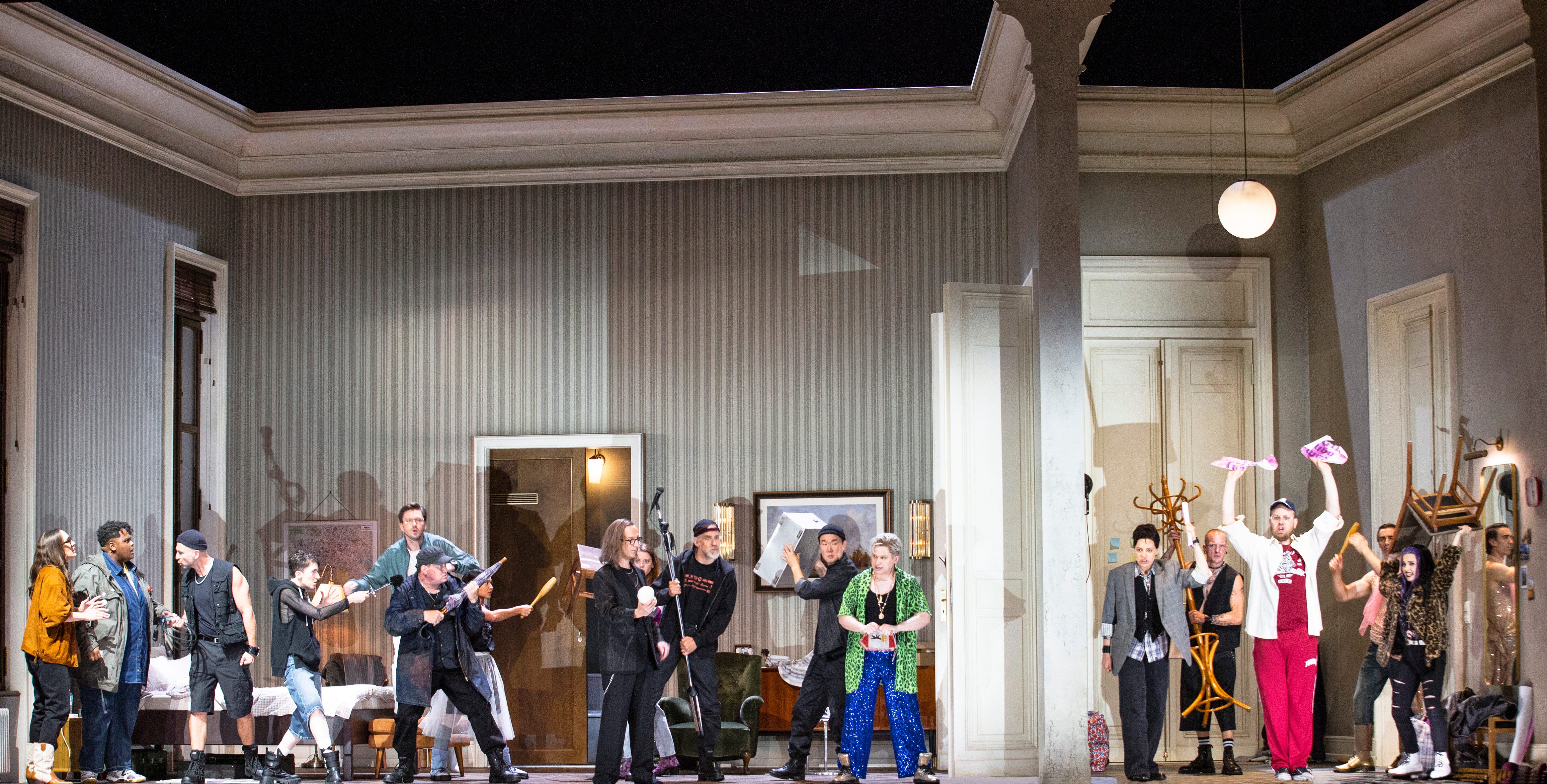
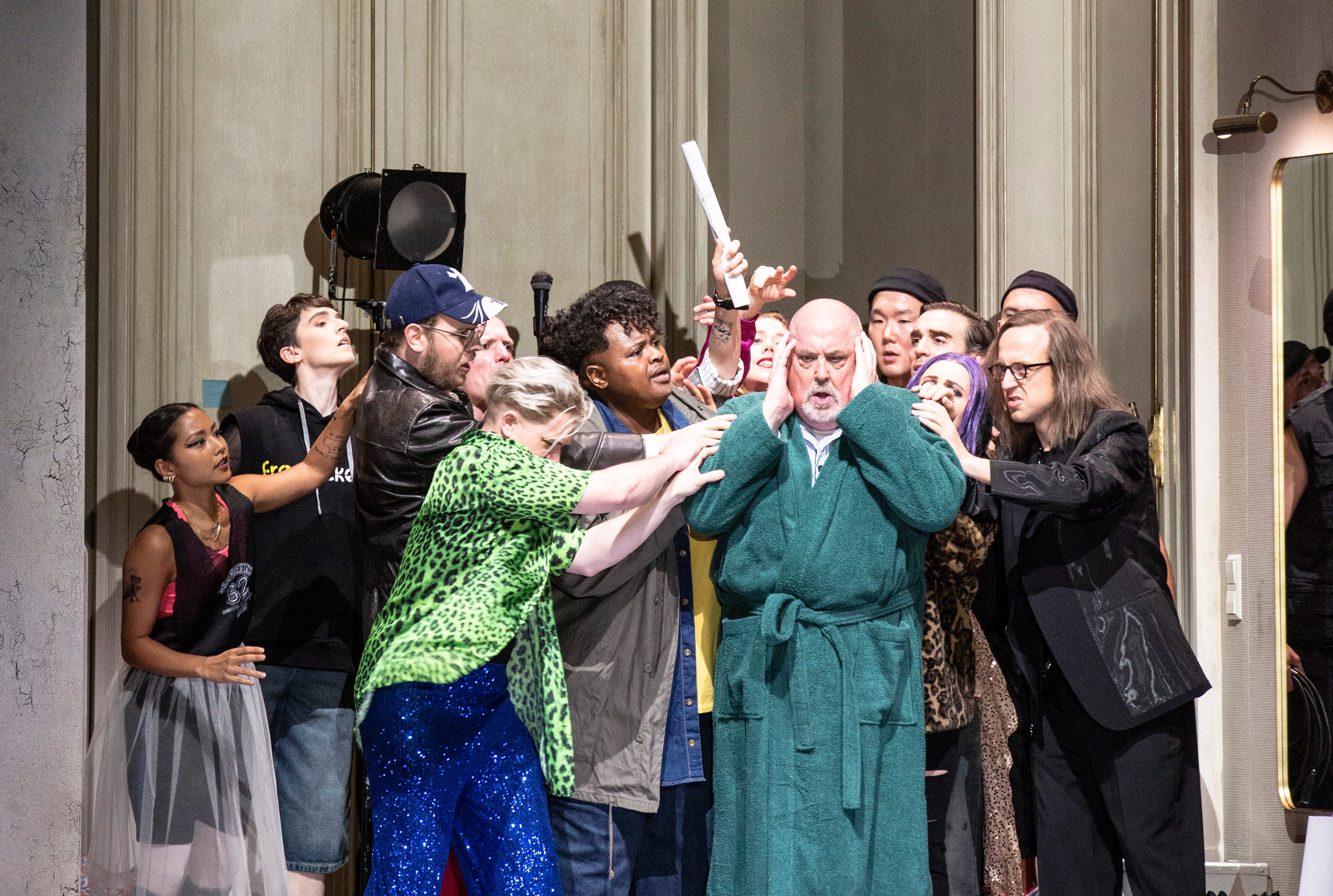
Director Jan Philipp Gloger’s production updated the action to the modern day, which felt more like a reflex than a considered decision. The libretto is so thoroughly steeped in the commedia dell’arte that its stock conceits (old husband-young wife, scheming housekeeper, and so forth) feel out of place in a modern high-rise, and there’s no obvious payoff to make the switch worthwhile. (Factoids about the health risks of living alone, projected onto the curtain in between acts, seemed particularly anomalous.) Still, the action itself was done with plenty of comic spark and the requisite touch of poignancy. I feel I can now put Die schweigsame Frau back on the shelf with no regrets.
Cryptic clue of the week
From Out of Left Field #321 by Henri Picciotto and me, sent to subscribers last Thursday:
Charlatan failing to replace sulfur in wine (4)
Last week’s clue:
Relief pitcher is warmer? (6)
Solution: CLOSER
Relief pitcher: definition
warmer: second definition
Coming up
• The Barber of Seville: After what’s felt like an interminable wait, the San Francisco Opera resumes operations this week with the summer programming that will conclude its 2025-26 season. Conductor Benjamin Manis returns to lead two casts’ worth of singers in Rossini’s perennial comic charmer, headed by baritones Joshua Hopkins and Justin Austin in the title role. Mezzo-sopranos Maria Kataeva and Hongni Wu (Rosina) and tenors Levy Sekgapane and Jack Swanson (Almaviva) divide the other principal roles. May 28-June 21. www.sfopera.com.
• A Little Night Music: Stephen Sondheim’s brilliant musical treatment of the Ingmar Bergman film classic Smiles of a Summer Night gets another transformation in the Redwood Symphony’s semi-staged presentation of the piece. Eric Kujawsky conducts the West Coast premiere of a new arrangement by longtime Sondheim orchestrator Jonathan Tunick, with a cast headed by Annmarie Macry and Mark P. Robinson. May 29-30, Cañada College Main Theater, Redwood City. www.redwoodsymphony.org.
• Doubt: John Patrick Shanley’s prizewinning play, about secrets and allegations in a Catholic school, is the basis for composer Douglas Cuomo’s 2013 opera, which Opera Parallèle presents in a new chamber version. Baritone Matthew Worth and soprano Rhoslyn Jones are the principal antagonists in a production conducted by Nicole Paiement and staged by Brian Staufenbiel. May 29-31, Presidio Theatre. www.operaparallele.org.
Chuck Corn and I interviewed Donald Runnicles at his parent's house on the Firth of Forth in the 80s. I videoed and taped. Chuck took notes for a profile he wrote for Chronicle Datebook. We saw Janet Eaglin perform for our first time in Edinburgh. Great talent, both.
My first encounter with a Strauss rarity came earlier this year with "Daphne," which, unlike "Die schweigsame Frau" does deserve to be heard more often. I assume the need for two tenors for two impossible parts is what keeps it from being done more regularly.
I have seen two Gloger productions, both updated for no good reason, and I was unimpressed by both.
Lucky you, seeing Runnicles! I hope he'll be back at SFO again, though with Kim proving to be an outstanding Wagnerism herself, I'm not sure where he would fit in.