
Modern family
The San Francisco Opera’s exhilaratingly fine Elektra revival connected past and present

Plenty of operas are burdened with silly, implausible plots, but Strauss’s Elektra isn’t one. That’s because the story comes from Sophocles, which is to say Greek mythology, which is to say the deepest, most implacable currents of human psychology. (Admittedly, I romanticize the ancient Greeks, but not by much.) When considered from the right perspective, the tale of the Atreides is the tale of every unhappy family — every spouse riddled with resentments, every child ready to blame a parent for their own life failures, every sibling waiting for someone else to say or do what’s required. You might object, I’ve never chopped off my mother’s head with an axe, and I’d reply, Please don’t be so literal. This is still your story, give or take.
That, at any rate, is the premise of director Keith Warner’s incendiary and riveting production, which returned to the San Francisco Opera on Sunday nearly a decade after its unforgettable first local mounting in 2017. It still packs a wallop, and Warner’s brilliantly inventive interpretation, staged here again by Anja Kühnhold, is a master class in telling old stories so that they resonate with living audiences.
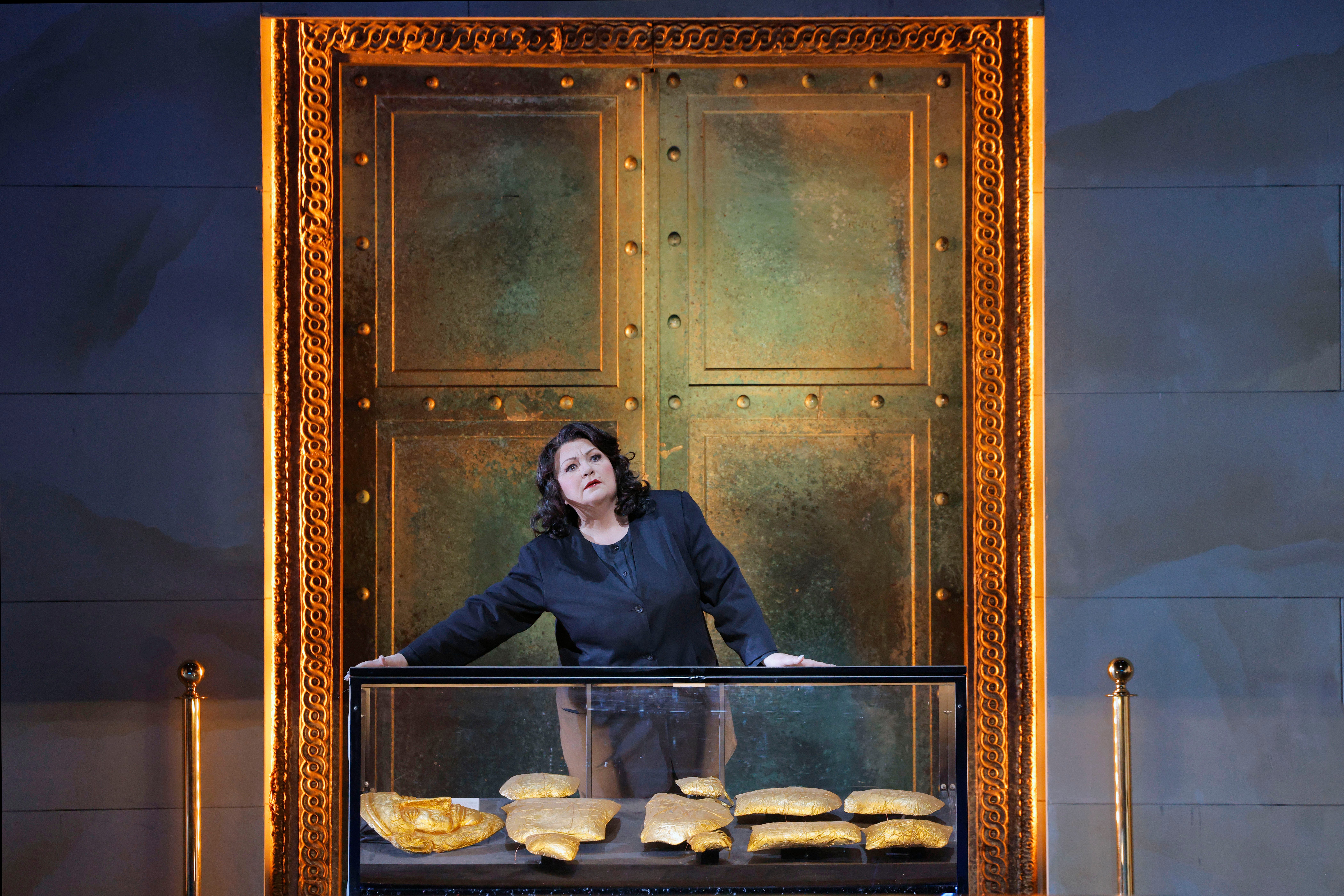
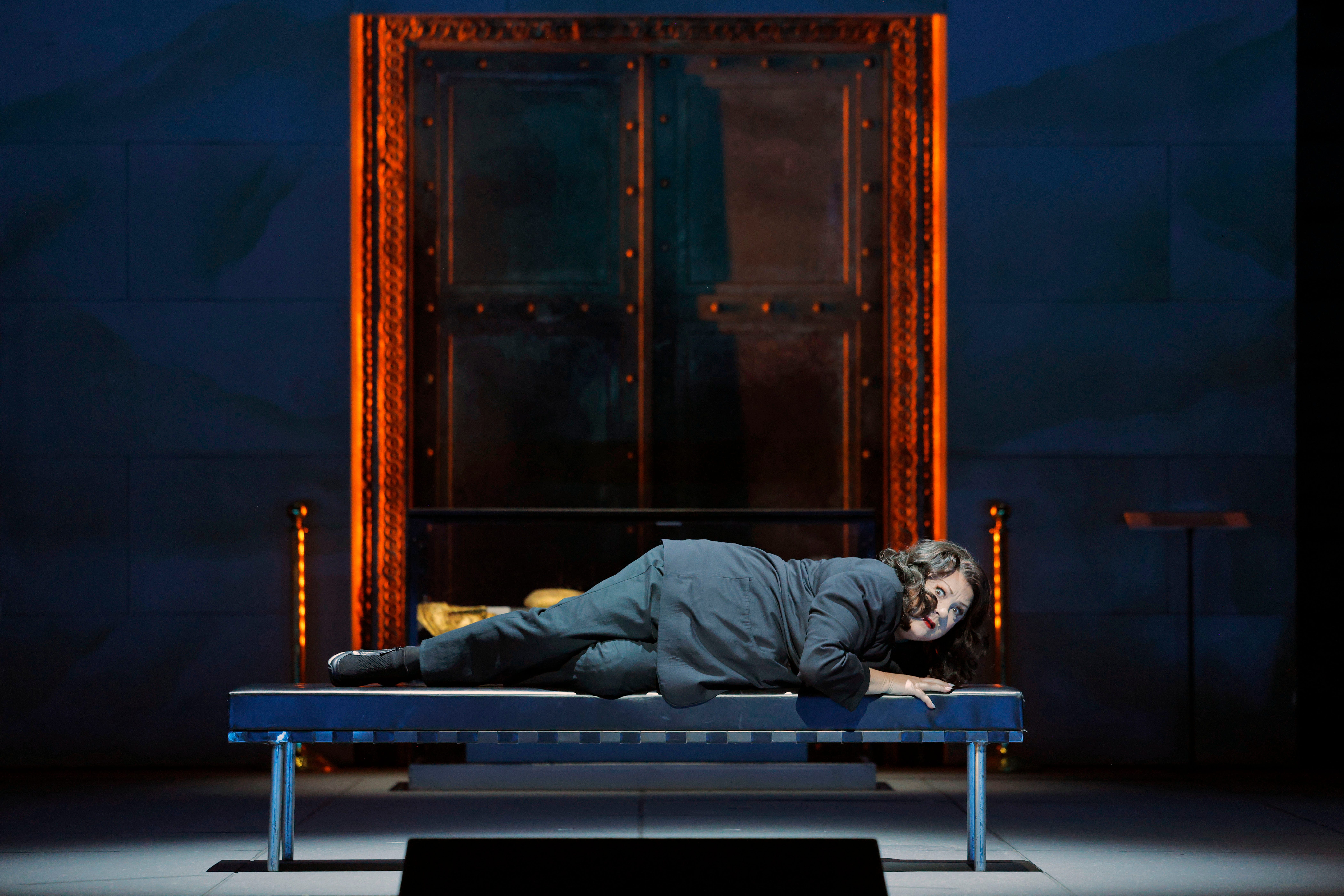
The trick is simple but effective: Depict that act of resonating directly on stage. Warner’s Elektra is set in a modern-day museum, where a special exhibition is devoted to both the Elektra myth and life in bronze-age Mycenae. There are display cases and video reels, and one particularly susceptible patron sees herself reflected so crisply in the story that she stays behind after closing time to explore the parallels more directly.
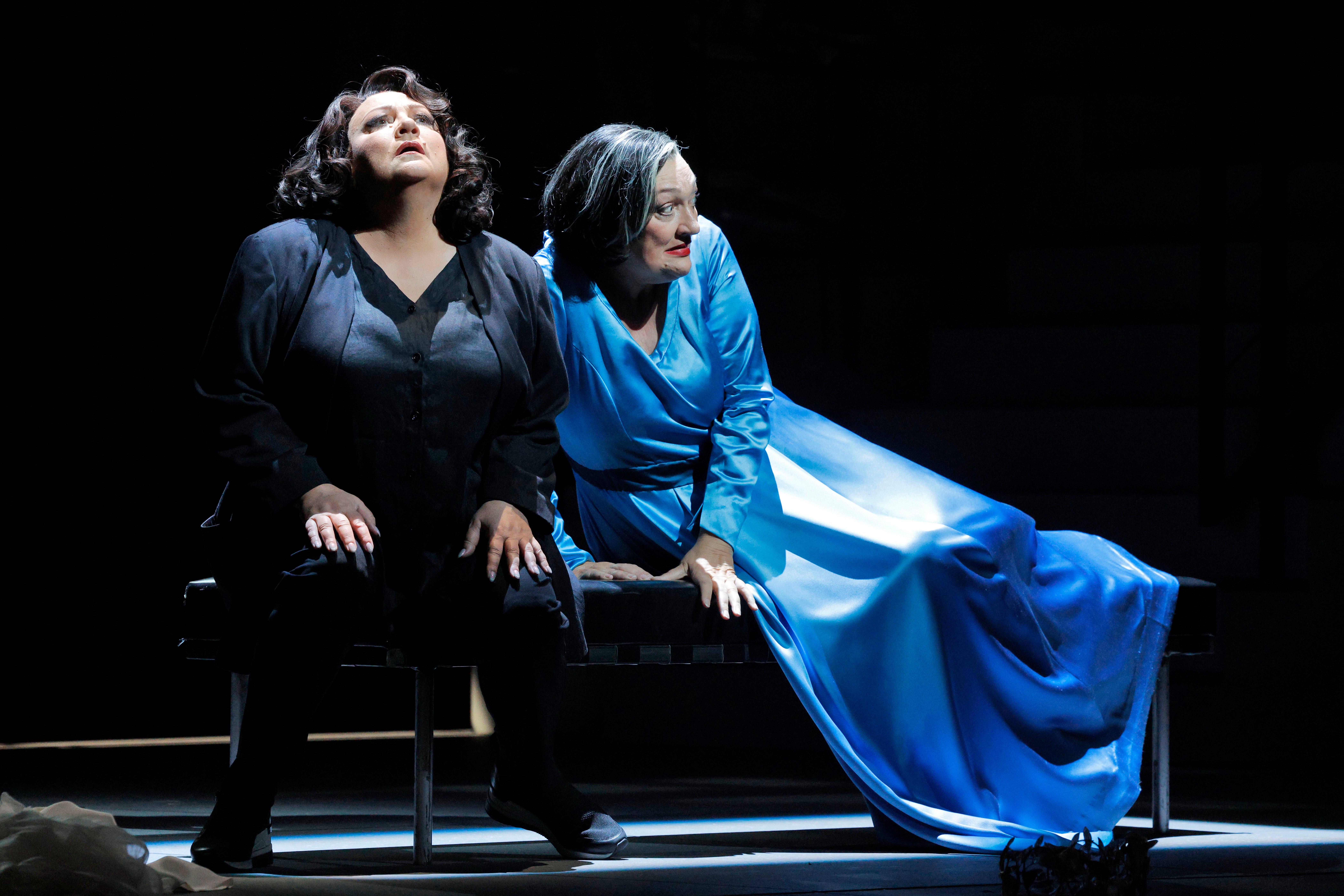
The performance of Strauss’s opera that follows is the unnamed protagonist’s reimagining of that story, with herself in the leading role. Flashbacks illuminate some of the backstory — the discovery of her father, dead in the bath like Agamemnon, or his funeral in a lace-curtained living room. But for the most part the immersion is psychological, a way for the central figure to use art as a way of confronting her own demons. (In this respect, the production rhymes fascinatingly with Oakland Theater Project’s recent production of Assassins.)
To work at its fullest, though, the production needs a leading soprano who can wrestle the entire dramatic and musical apparatus into place around her. An ordinary production of Elektra is about Elektra by default, whereas this version only exists through the deliberate force of the main character’s will. When Christine Goerke inhabited the role in 2017, she was such a vortex of energy and emotional need and pyrotechnics that you could believe her capable of conjuring up an Expressionist firestorm where none had existed. She was, persuasively, both protagonist and puppetmaster.
Elena Pankratova, the Russian soprano making her company debut in the revival is…not that. Her singing is tonally alluring, and often boasts a winning degree of precision; there’s a clarity and expressiveness on display in the opera’s more intimate passages that tugs at your heart. But on opening day she didn’t consistently have the requisite vocal power for the task. The Elektra score is a fearsome, pitiless beast, and whenever things ratcheted up, the orchestra just took Pankratova’s lunch money. The high notes sailed through the din, but anything below that tended to fade toward inaudibility.
One might argue that it was music director Eun Sun Kim’s responsibility to modulate the balances so that Pankratova’s singing could come through better, and ordinarily I’d be receptive to such a position. But a) no one else in the cast had any trouble, b) a modulated Elektra is in no one’s interest, and c) this was one of Kim’s most majestic conducting performances to date. Elektra famously calls for the largest orchestra of any opera in the standard repertoire, and Kim handled it all flawlessly. She shaped great swaths of orchestral sound that filled the War Memorial Opera House with a dazzling sheen, then brought out a wealth of intricate detail without breaking stride. Along with her recent Parsifal and Tristan, this performance left me even more optimistic about the company’s upcoming Ring Cycle in 2028.
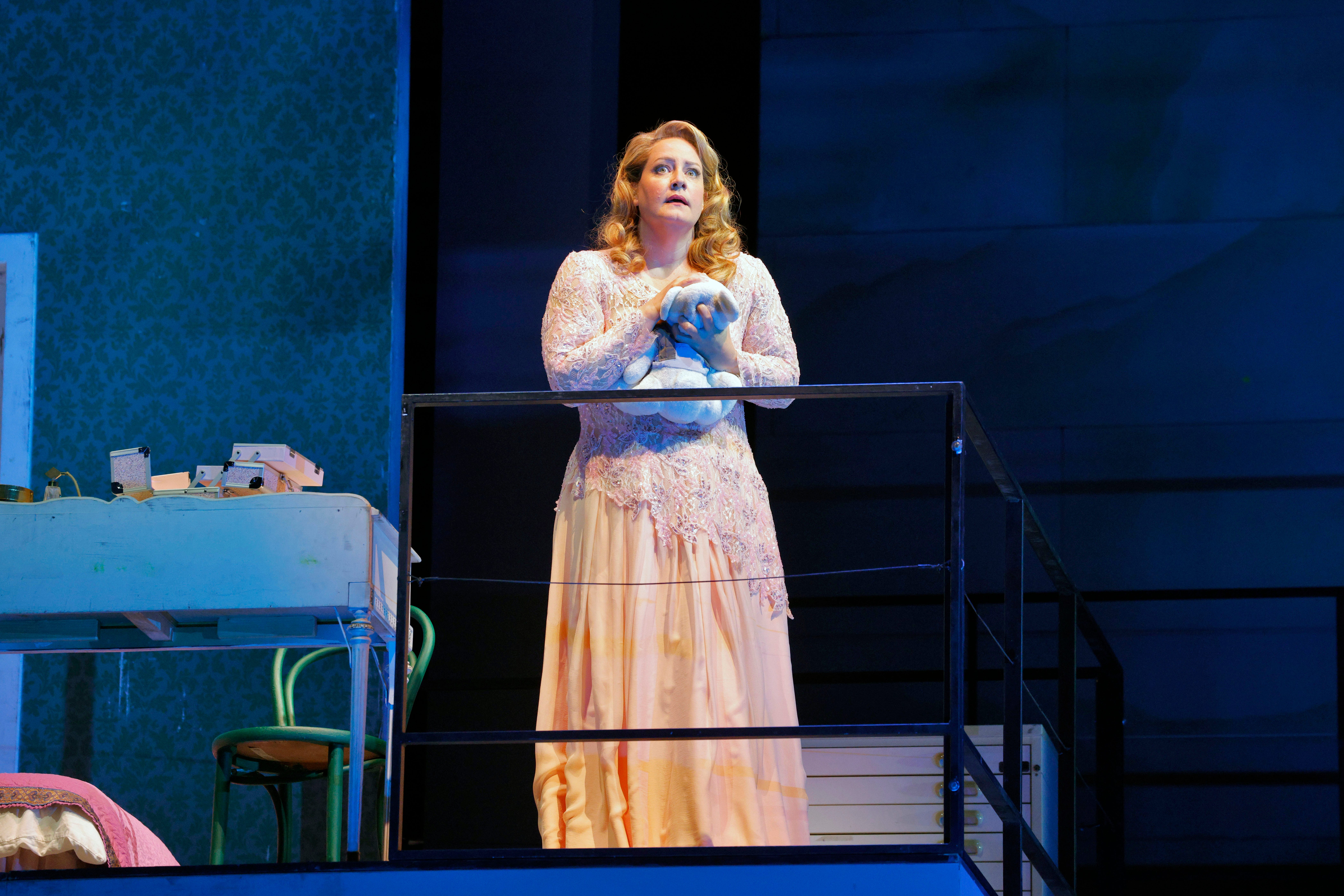
The remainder of the cast, too, rose admirably to the score’s challenges. In particular, Elza van den Heever’s breathtaking performance as Elektra’s sister Chrysothemis was a virtuoso display of vocal muscle, effortless phrasing and extraordinary stamina — the musical centerpiece of the entire undertaking. When van den Heever was starting out in the San Francisco Opera’s training wing in the first decade of the century, it was obvious she was going places; but honestly, I’m not sure it was apparent she was going to develop into an artist of quite such expressivity and vocal resourcefulness.
The production also benefited from masterful turns by Michaela Schuster (Klytemnestra), Kyle Ketelsen (Orest), and William Burden (Aegisth), each in turn doing their bit to make the all-enveloping drama that much more compelling. You’ll leave the Opera House feeling shaken, exhilarated, and perhaps just a bit more uneasy about your own relatives than you did going in.
Elektra: San Francisco Opera, through June 27. www.sfopera.com.
Elsewhere:
Lisa Hirsch, San Francisco Chronicle/SFCV: “As in 2017, the production is a triumph for all involved…Kim leads with propulsion and breathtaking control over the immense orchestra — Strauss never met an instrument he couldn’t stuff into a score — and miraculously retains clarity even in the loudest passages, of which there are many.”
Gabe Meline, KQED: “The real star of the show, however, is below the stage. Elektra brings with it the largest orchestra the Opera House has ever seen: 95 musicians, fueled by Eun Sun Kim’s baton and charging through Richard Strauss’ score like a locomotive.”
Harvey Steiman, Seen and Heard International: “The final few minutes reached a summit of exaltation and musical expansiveness that was simply breathtaking. After all the intensity from a sensational cast and orchestra, the roar of appreciation from the audience was almost as thunderous as the music.”
Hercules redux
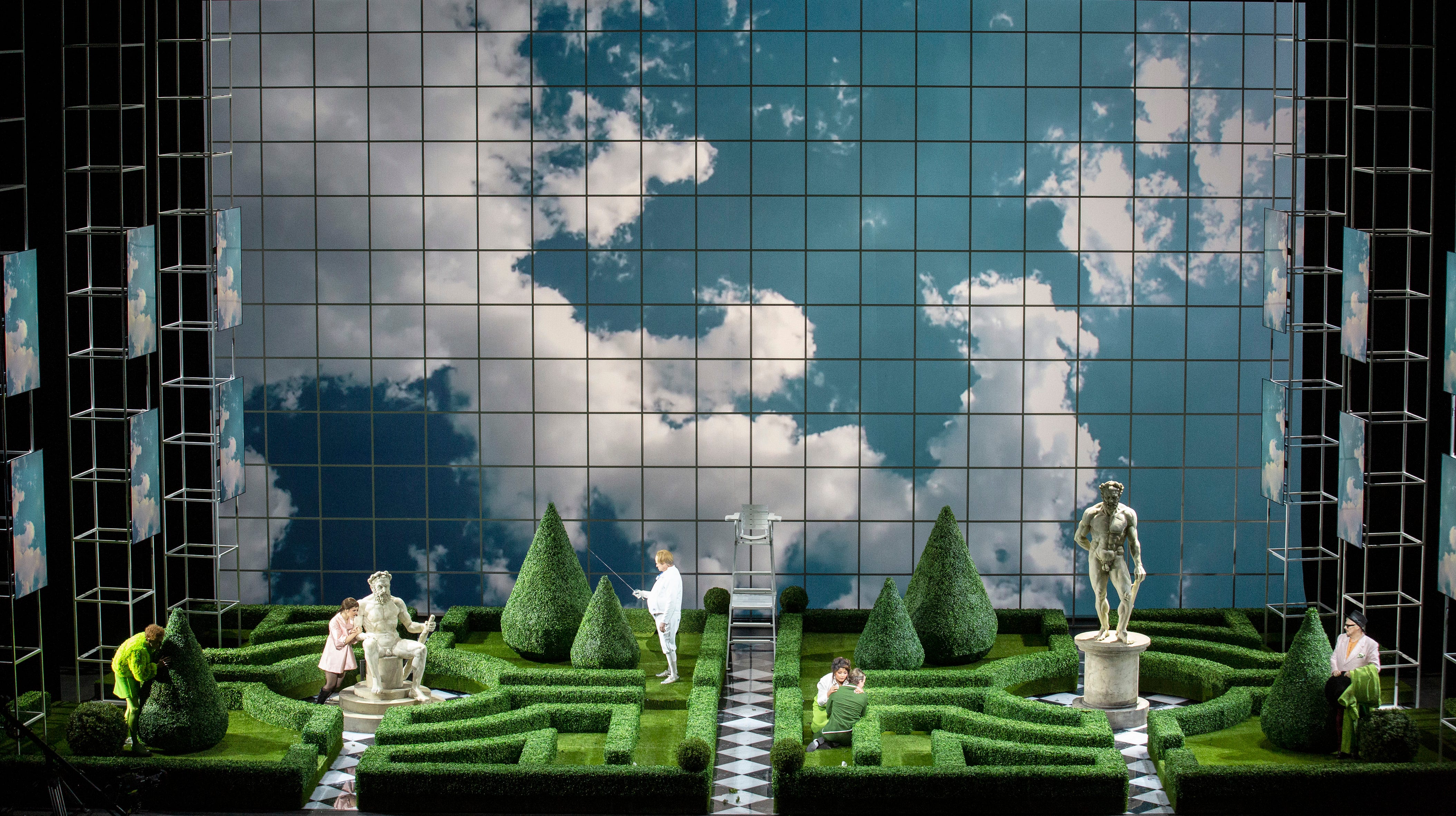
In November, when Ars Minerva introduced the Bay Area, and in fact the United States, to Antonia Bembo’s 1707 opera Ercole amante (Hercules in Love), it was hard to work up much enthusiasm for the piece. Long and static, the opera seemed to flit from subject to subject without settling on any dramatic point, and the music, in spite of some attractive vocal writing here and there, sounded thin and watery. Still, I reserved judgment on the score because the production itself was uncharacteristically ragtag. Perhaps, I thought, there’s a better case to be made.
Last week I found myself in Paris for the second week of my European travels, only to discover that the Opéra National de Paris was staging Ercole amante for the first time. In Paris, the piece enjoyed a huge, visually resplendent staging, full of movement and spectacle; a strong cast of international singers; and a conductor (Leonardo García-Alarcón) with a passionate commitment to Bembo’s music and the podium skills to bring out whatever is vital and exciting in her score.
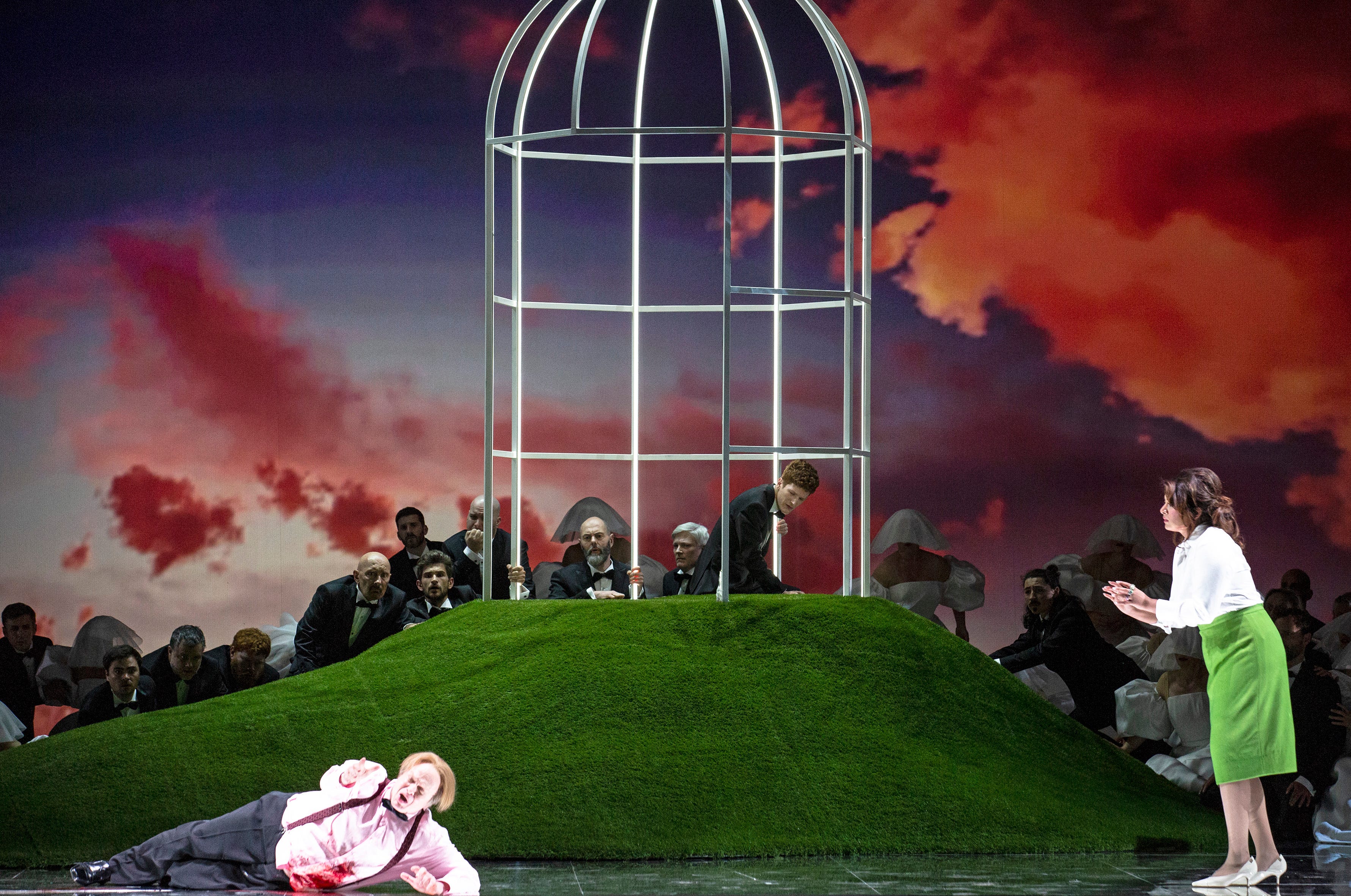
It wasn’t enough. Even under what must surely be optimal conditions, Ercole amante contains little to quicken the pulse, and plenty to keep you checking your watch over the course of 3½ directionless hours. Characters fall in love, die, threaten one another, and run interference for various thin-skinned gods, all as a pretext for musical rewards that by and large don’t materialize. Following the plot became easier once I realized that it tracks with Handel’s Hercules, which was relatively fresh in my mind from the excellent March performance by The English Concert at Cal Performances. But that didn’t do much to alleviate the tedium.
Bembo, who died around 1720, was a student and protegée of the Venetian master Francesco Cavalli, and she spent most of her career in Paris. Depending on who you listen to, her writing represents a French inflection of the Venetian style of the day, or the other way round, or maybe a synthesis of the two. In a gushy program interview, García-Alarcón says her musical language is like no one else’s, and I can do no more than take him at his word. The finest passages in Ercole amante, Bembo’s only opera, are detachable set pieces — a grand funeral chorus, a spooky scene in the underworld, a trio of exquisite intricacy to conclude the fourth act (out of five). Those left a listener in awe, but they also felt like standouts in a fairly drab stream of musical chitchat.
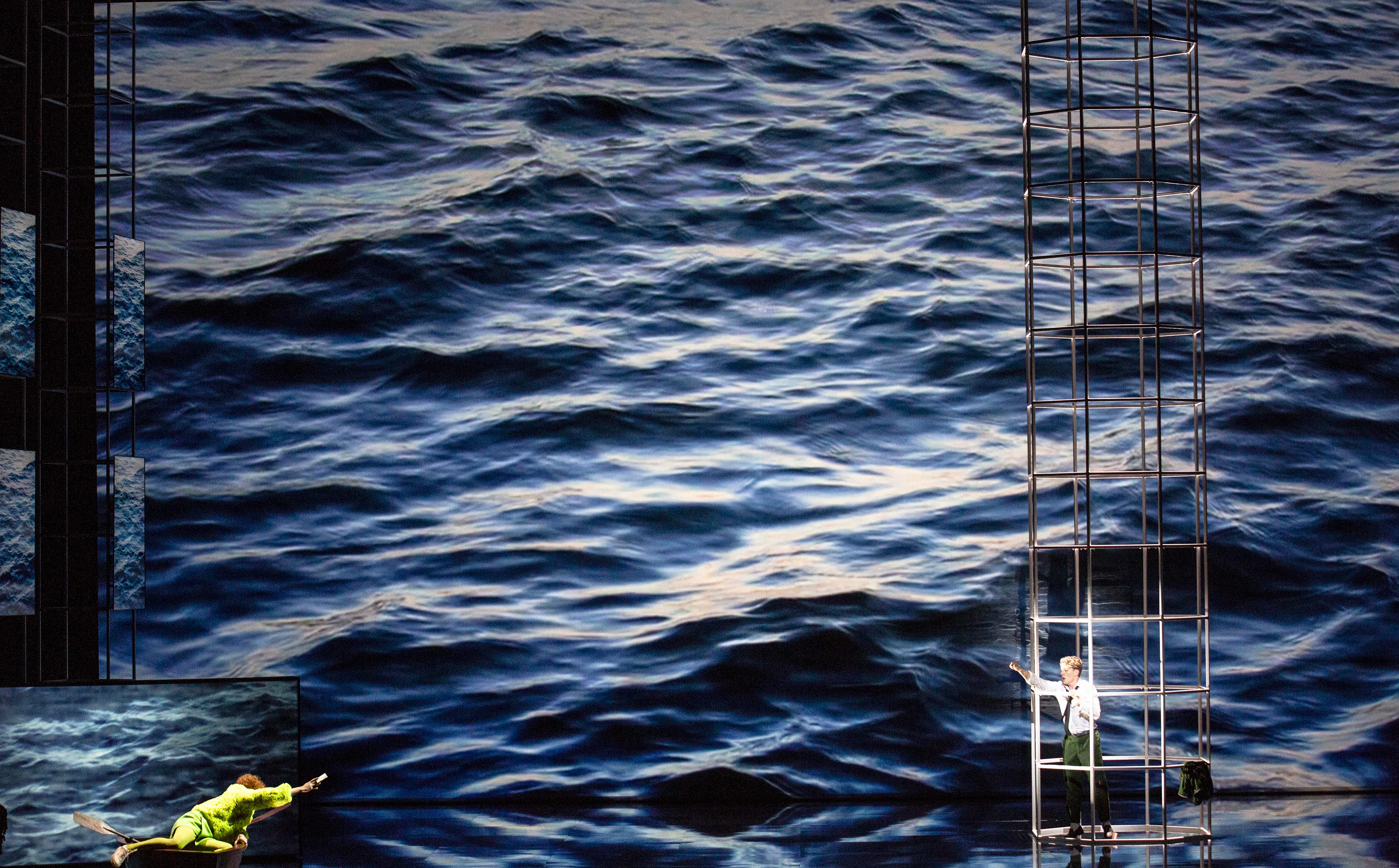
If nothing else, director Netia Jones’ staging was a marvel to look at, with vast theatrical panoramas — now brightly sharp-edged, now shadowy and elusive — filled with sprightly action. A sports motif called for a corps of dancers to appear as fencers, tennis players, runners, and so forth, which didn’t seem to mean much dramatically but looked terrific.
The clear vocal standout in a large cast was mezzo-soprano Deepa Johnny, whose singing as Hercules’ wife Deianira was full-bodied and richly expressive throughout. (Some fortunate locals may remember Johnny from her 2022 turn as Cherubino in Opera San José’s Indian-themed Marriage of Figaro.) Bass Alex Rosen made a thrilling contribution as Neptune, and Marcel Beekman and Théo Imart worked beautifully together as the rather mismatched pair of servants who provide the piece’s comic relief. The chorus, led by Thibaut Lenaerts, sounded splendid.
Still, none of it sufficed to make a listener believe that there’s anything important here we’ve been missing all these centuries. One wants to believe that Bembo’s genius has been wrongfully overlooked, most likely for reasons of gender, and that a Cinderella-type rediscovery is precisely what the opera world needs. I just can’t see it.
Elsewhere:
Nigel Wilkinson, Parterre Box: “This was a fine production, neatly directed and with lots of ingenious little details, by turns funny and moving, three hours long but never flagging.”
Cryptic clue of the week
From Out of Left Field #323 by Henri Picciotto and me, sent to subscribers last Thursday:
Bishop on whaler smuggling drugs? To begin with, it is something you should stop doing (3,5)
Last week’s clue:
Start to notice loose chat, of course (5)
Solution: NATCH
Start to notice: N
loose: anagram indicator
chat: anagram fodder
of course: definition
Coming up
• Alcina: Handel’s scintillating opera of enchantment and seduction comes to Festival Opera for four performances — twice unstaged, as part of the Berkeley Festival & Exhibition, and twice fully staged at the company’s home in Walnut Creek. Mezzo-soprano Nikola Printz stars in the title role, alongside Courtney Miller, Shawnette Sulker, Sara Couden and more, under the baton of Derek Tam. June 13 & 14. Hertz Hall, UC Berkeley. June 19 & 21, Lesher Center for the Arts, Walnut Creek. www.festivalopera.org.
• Berkeley Community Orchestra and Chorus: As part of a season devoted to weighty sacred choral works, music director Ming Luke leads his forces in the world premiere of Terezin Requiem by the Vermont composer Michael Schachter. Haydn’s Theresienmesse completes the program. June 12-14. First Presbyterian Church, Berkeley. www.bcco.org.
Delighted to read your comments about Eun Sun Kim as I am, tentatively at least, planning to come to SF for the 2028 Ring.
100% agreement, particularly on how great Kim is. My only question: she is so good in the Runnicles lane that I wonder if we will ever see him at SFO again. Like you, I am a fan.
Re Pankratova, I think she is vocally somewhat miscast as Elektra. She is a high-note singer and much of Elektra lies in the middle and low registers, where Goerke has a huge and beautiful sound.
Re Elsa van den Heever, I think what we heard the other day might be the biggest sound I have ever heard a singer make.